
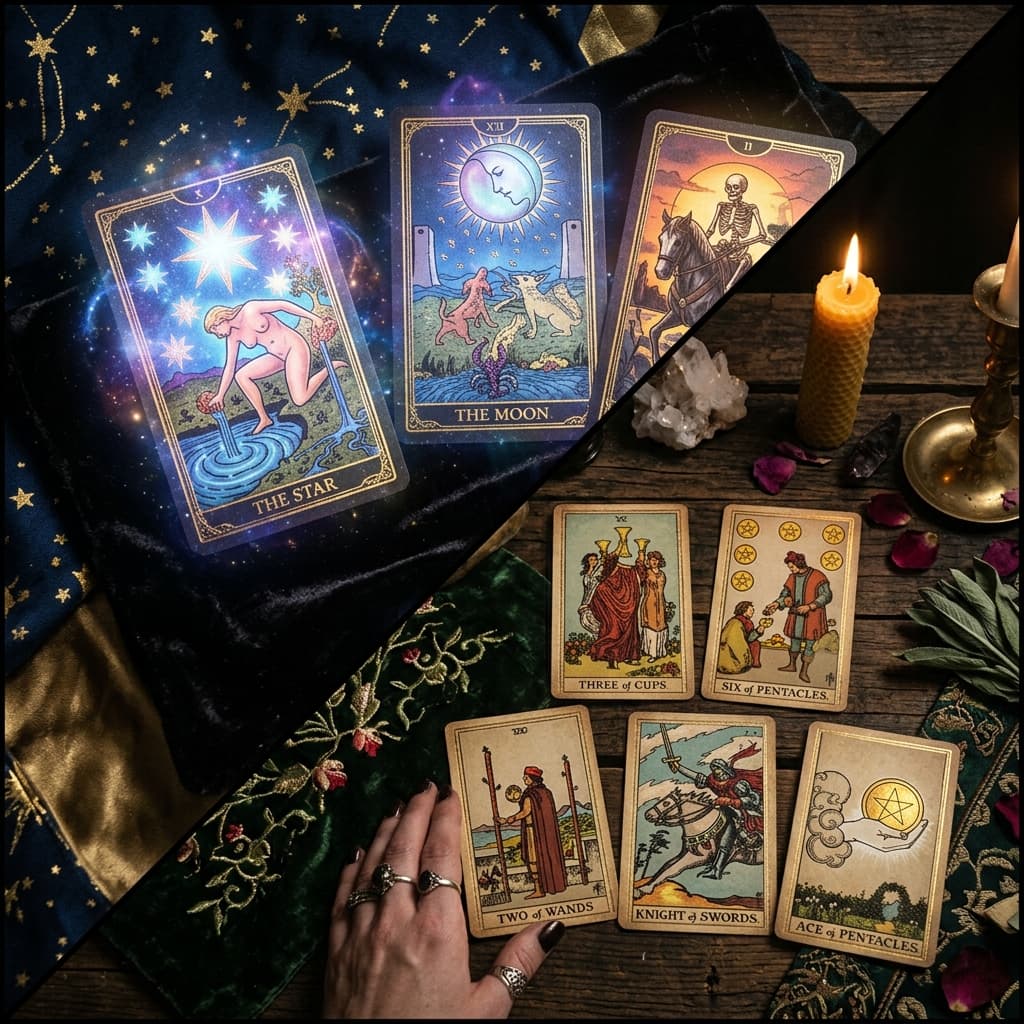
A three-card tarot spread is the simplest layout: you draw three cards and give each one a position you chose in advance. The best-known version is past, present and future, with variants such as situation, obstacle and advice. The real reading appears when you read the cards together rather than one by one.
This guide treats tarot as entertainment and a tool for reflection; the cards are no substitute for health, legal or financial decisions.
Why is the three-card spread so popular?
Three cards rescue a question from both the thinness of a single card and the sprawl of a ten-card layout. One card is a snapshot; three cards tell a short story with a beginning, a middle and a direction. Each card gets enough attention, which makes the spread friendly for beginners and for anyone who wants a quick morning check-in.
Questions that need a wider picture usually go to the ten-card Celtic Cross. This guide stays with the three-card layout and how to read it well.
Which three-card variants exist, and which should you choose?
The strength of the spread is its flexibility. The cards stay the same; what changes is the question you ask each position. The table shows five common variants and the kind of question each one suits.
| Variant | Positions | Best for |
|---|---|---|
| Past, present, future | Root of the matter, current situation, likely direction of the present course | Things that unfold over time: a relationship, a job, a move |
| Situation, obstacle, advice | What is happening, what stands in the way, what to focus on | Topics where you feel stuck and are weighing what to do |
| You, the other person, the bond | Your stance, their stance, the relationship itself | Relationships, friendships and partnerships |
| Option A, option B, criterion | First path, second path, what to weigh when deciding | Being torn between two choices |
| Mind, body, spirit | Thoughts, energy and routine, inner voice | A general check-in without a specific question |
Pick the variant before you shuffle. Changing positions after you have seen the cards is the easiest way to bend a reading toward the answer you wanted.
How do you read a three-card spread step by step?
- Write an open question. "What should I pay attention to at work in the coming weeks?" leaves the cards more room than "Will I get promoted?"
- Decide on the variant, and on whether you use reversed cards, before shuffling.
- Shuffle and lay three cards from left to right. The first card is the left-hand position.
- Read each card on its own first, then in the light of its position.
- Look at the links between the cards: suits, numbers, how many Major Arcana cards appear and which way the figures face.
- Combine the three cards into a single sentence and write it down. Rereading the note a week later shows you what the spread made you think about.
How do you read the links between three cards?
Step five is what turns a three-card spread into more than a list of meanings. Suits give the first clue: Cups speak of feelings, Swords of thoughts and words, Wands of drive and action, and Pentacles of concrete matters such as money, work and the body. Three cards from one suit suggest the question is concentrated in a single area of life, while three different suits suggest a process moving from one area to another. Numbers are the second clue. Low numbers describe beginnings and high numbers the ripening or fatigue of a cycle, so rising or falling numbers from left to right show which way the story is flowing. The count of Major Arcana cards matters too: when two or three of the cards are Major Arcana, the question is read as touching a larger life theme rather than an everyday matter. Finally, watch where the figures look; figures facing each other suggest connection, and figures turned away suggest a gap.
Worked example: what do the Five of Cups, Two of Swords and Ace of Wands say together?
The question: "Should I go back to a project I abandoned?" The variant is past, present and future, with no reversals. The cards, in order, are the Five of Cups, the Two of Swords and the Ace of Wands.
Past, Five of Cups: a cloaked figure stares at three spilled cups while two cups still stand behind them. The traditional meaning is loss, regret and dwelling on the past. Here it describes the disappointment felt when the project was dropped.
Present, Two of Swords: a blindfolded figure holds two crossed swords. A hard choice and a stalemate, keeping balance by not looking at the facts. The present seems to be less about missing information and more about putting the decision off.
Future, Ace of Wands: a hand from a cloud offers a sprouting wand. A new spark, inspiration and the energy of a beginning. If the current course continues, the project could come back to life.
What do these three cards say when read together?
Read together, the three cards tell a story none of them tells alone. The suits move from Cups to Swords to Wands, so the process flows from feeling to thinking and from thinking to action. The numbers fall from five to two to one: the load gets lighter and the story simplifies toward a fresh start. There is no Major Arcana card in the spread, which suggests an everyday decision in the person's own hands rather than a great turn of fate. The most interesting link runs between the two cups still standing in the Five of Cups and the Ace of Wands: what was not lost can become the material for a new beginning. A one-sentence summary might read: "An old disappointment has turned into a stalemate; if you take off the blindfold and look at what you still have, the project can restart from a small spark." That is a frame for reflection, not a verdict.
How do the same cards read in another variant?
Read the same cards as situation, obstacle and advice, and the emphasis shifts. The Five of Cups becomes the situation, with attention still fixed on what was lost. The Two of Swords becomes the obstacle, the habit of postponing. The Ace of Wands becomes advice: start with one small step instead of a grand plan.
What are the most common mistakes with three-card spreads?
- Asking the same question again and again. Redrawing straight after a spread you did not like makes it harder to hear the first one.
- Treating the future card as a verdict. It shows where things may head if the present course continues, not a fixed ending.
- Reading the cards without combining them. Listing three separate meanings skips the most valuable part of the spread.
- Asking yes-or-no questions. The layout is built to describe a process, so expecting a clean yes or no usually adds confusion.
How can you try your own three-card spread?
The six steps above are all you need with your own deck. To refresh card meanings, the tarot guide has a page for each of the 78 cards, and the three-card spread glossary entry gives a short definition. On Faltastik you can choose the Three Card layout when you open a tarot reading, and your cards are read in the past, present and future positions for your question.
