
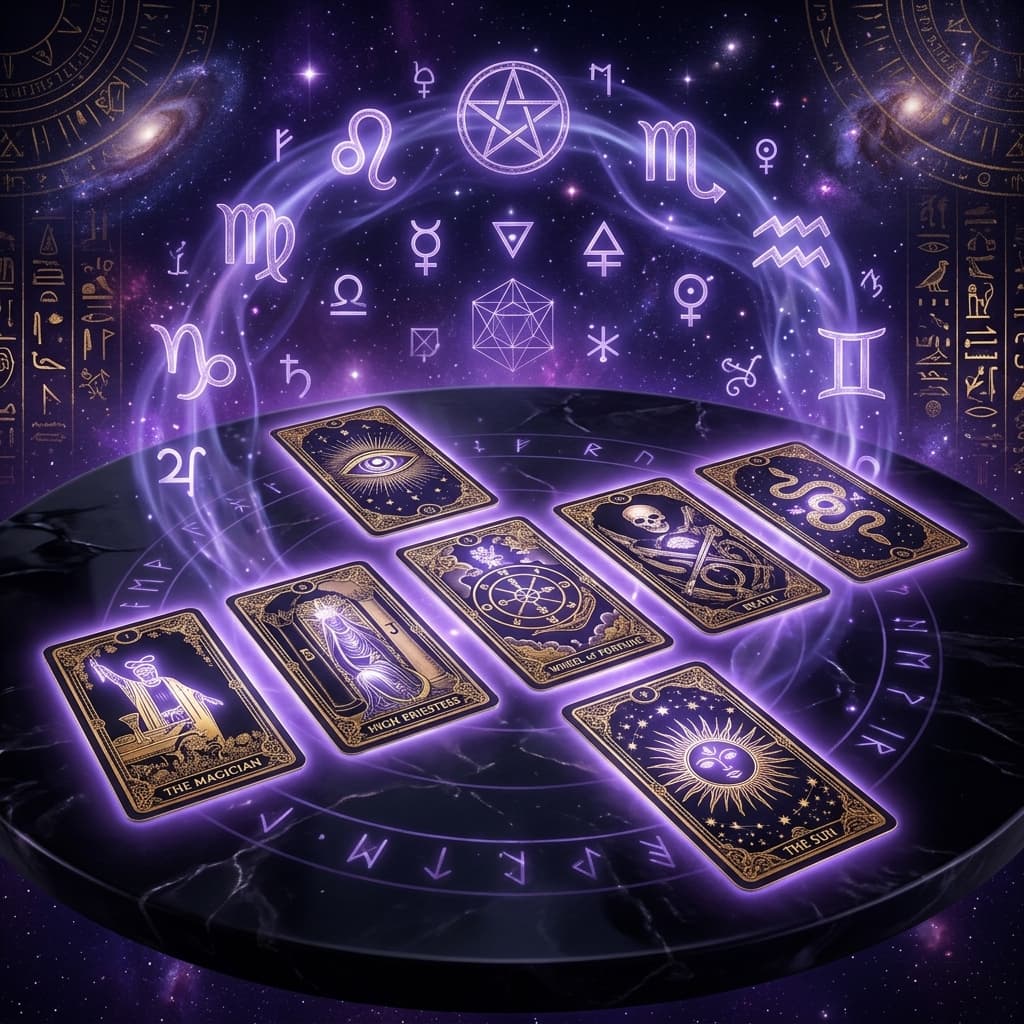
A reversed tarot card lands upside down in a spread, and most readers do not treat it as the exact opposite of its upright meaning. They read it as the same energy in another state: blocked, turned inward, overdone or changing direction. The right approach depends on the question, the nearby cards and the reader's own rule.
This guide treats tarot as entertainment and a tool for reflection; no card, upright or reversed, replaces health, legal or financial decisions.
Why do reversed cards appear, and does every reader use them?
Some cards turn around naturally during shuffling, and some readers split the deck and rotate one half on purpose to make reversals more likely. A. E. Waite's 1910 guide to what is now the most widely used deck gives a separate reversed meaning for every card. Even so, reversals are optional. Many readers keep every card upright and adjust each card's weight according to its neighbours.
For a short definition and some history, see the reversed card glossary entry. This guide goes a step further: how to read a reversal in practice and how to choose an approach.
What are the four ways to read a reversed card?
There is no single correct reversed meaning. Readers usually use one of the four approaches below, sometimes two together.
| Approach | Question to ask the card | When it works |
|---|---|---|
| 1. Blocked or delayed energy | Why can this card's energy not flow yet? | When the upright meaning fits the question but the situation is not moving |
| 2. Inward energy | Is this happening inside me rather than around me? | Personal growth and emotional questions |
| 3. Excess or deficiency | Is there too much or too little of this card's quality? | Cards with a strong single quality, such as Strength, the Sun or the Queen of Swords |
| 4. Opposite meaning | Is the process this card describes turning around? | Cards about pain, loss or conflict, where it often signals a positive turn |
How do you choose between the four approaches?
The most reliable way to choose between the four approaches is not to read the card in isolation. Start with its upright meaning, then look at its position: a reversed card in the past position often points to unfinished business, while a reversed card in the advice position often warns against an excess. Next, read the neighbouring cards. If the reversal sits beside cards of movement and new beginnings, the blocked-energy approach usually makes more sense, because the energy is trying to find a way through. If it sits beside inward cards such as the Hermit or the Moon, the inward approach comes forward. Finally, look at the spread as a whole. When most of the cards come up reversed, many readers treat that less as a string of reversed meanings and more as a sign that the matter is stuck or the question is not ripe yet. Whatever you choose, staying consistent within one spread keeps the reading clear.
How are the Tower, the Sun and the Three of Swords read upright and reversed?
These three cards show why reversals cannot be reduced to one rule. The meanings match the traditional ones on the card pages of this site.
| Card | Upright | Reversed | Approach that fits |
|---|---|---|---|
| The Tower | Sudden change, old structures collapsing; shocking but freeing | A crisis avoided or dragging on, change postponed | Blocked or delayed energy |
| The Sun | Joy, success, vitality, everything coming to light | A passing cloud, too much optimism | Excess or deficiency |
| Three of Swords | Heartbreak, grief, separation | Healing begins, forgiveness, letting the pain go | Opposite meaning |
When the Tower is reversed, the collapse does not disappear; it is postponed. The upright Tower shows a structure falling all at once. The reversed Tower suggests that something which needs to fall is being propped up, and change is being held down. That is why the reversed Tower can feel more uncomfortable than the upright one.
When the Sun is reversed, it does not mean unhappiness. The Sun is the brightest card in the deck, and its reversal describes that brightness clouding over for a while or tipping into excess: too much optimism, unrealistic expectations, success arriving later than hoped. Reading the Sun with the opposite-meaning approach and calling it a dark period misses the nature of the card.
Why can a reversed Three of Swords be a good sign?
The Three of Swords is one of the clearest examples that a reversed card is not always negative. Upright, it shows three swords piercing a heart and speaks of heartbreak, grief and separation. Reversed, the same pain is read as changing direction: healing has begun, forgiveness has become possible, and the person is ready to let the hurt go. Here the opposite-meaning approach is the most natural one, because the card's subject is already a wound, and the reverse of a wound is healing. Position still matters. In the past position, a reversed Three of Swords can say that an old hurt has largely closed; in the future position, it can describe relief that may come if the present course continues. The example shows why expecting bad news the moment a card appears upside down is misleading. With cards about pain, loss or conflict, the reversal often marks the moment that hard process starts to loosen.
Are reversals read differently in the Major and Minor Arcana?
The method is the same, but the weight differs. Major Arcana cards describe life's larger themes, so their reversals usually suggest a longer blockage or a postponed turning point. Minor Arcana cards sit closer to everyday events, and a reversed Minor card more often describes a short delay, a hiccup or a shift in attitude. With court cards, a reversal can show the person or attitude the card stands for in an immature or exaggerated form. A reversed Queen, for example, can describe care that has turned into control.
When is it better not to read reversals?
- When you are new to tarot. Getting comfortable with the upright meanings of all 78 cards first makes reversals easier to build on.
- When you did not set the rule in advance. Deciding to use reversals only after one shows up bends the reading toward whatever you prefer.
- In single-card daily draws. With no neighbours to give context, a reversal is often read more heavily than it deserves.
- When most of the spread is reversed. One overall judgement about the spread usually says more than reading each card reversed.
What should you do, step by step, when a reversed card appears?
- Recall the upright meaning; the reversed meaning always grows out of it.
- Try the four approaches in turn and see which one fits the question best.
- Check the card's position and its neighbours.
- Write down the approach you chose in a single sentence.
To refresh card meanings, browse the card pages in the tarot guide. When you open a tarot reading on Faltastik, your cards are read for your question and their place in the spread.
