
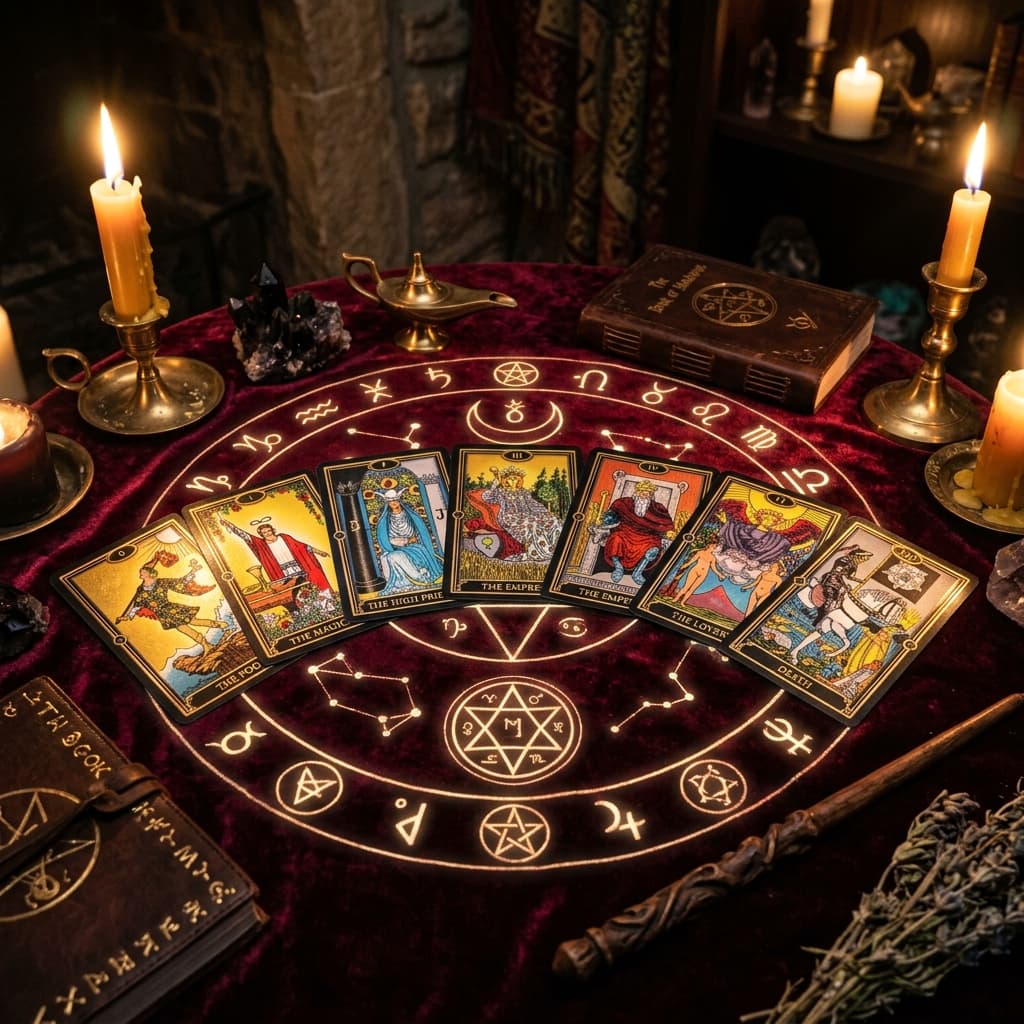
The Major Arcana is the part of the tarot deck, 22 cards in all, that deals with life's large themes. The easiest way to learn these cards is to read them as the story of a traveller called the Fool. A common approach splits the Fool's journey into three groups of seven: learning the outer world, turning inward and transformation.
This guide treats tarot as entertainment and a tool for reflection; the cards are not a substitute for medical, legal or financial advice.
What is the Major Arcana, and why are there 22 cards?
A tarot deck holds 78 cards: 56 form the Minor Arcana, which describes everyday events, and 22 form the Major Arcana. When tarot was born as a card game in fifteenth-century Italy, these were the picture trumps added to the deck to beat the other cards. Their number comes from the structure of that game; in the nineteenth century some writers matched them to the 22 letters of the Hebrew alphabet and gave them a new symbolic layer.
Today the Major Arcana are seen as the cards that set the theme of a reading. A Minor card may describe a week-long situation, while a Major card points to a longer period, a life lesson or an inner transformation. Each card carries an archetype, a figure or situation that keeps recurring in human experience: the teacher, the mother, the warrior, the hermit or the person reborn. For a short summary, see the Major Arcana glossary entry.
What is the Fool's journey?
The Fool's journey reads the Major Arcana in order as a single story. The Fool, numbered zero, is a curious and innocent traveller walking at the edge of a cliff with a small bundle. The zero gives him a special place: he stands at the start of the journey and also passes through every other card. In a reading he usually means a new beginning, curiosity about the unknown and sometimes a slightly careless leap.
Along the way the Fool meets a new teacher, test or experience in each card. He learns to use his will from the Magician, to listen to intuition from the High Priestess and to build order from the Emperor. Then he turns inward, faces loss, sheds an old identity and finally completes a cycle in The World, card 21. The value of this frame is that you remember the cards as one developing story instead of 22 disconnected meanings. The Fool's journey entry covers its history and variations.
How is the Major Arcana divided into three groups?
Set the Fool aside as the traveller and 21 cards remain. Laying them out in three rows of seven is a learning method used in many tarot books. The table shows the three groups in Rider-Waite-Smith order.
| Group | Cards | Core theme |
|---|---|---|
| Group 1 (1-7) | Magician, High Priestess, Empress, Emperor, Hierophant, Lovers, Chariot | Learning the outer world, building an identity |
| Group 2 (8-14) | Strength, Hermit, Wheel of Fortune, Justice, Hanged Man, Death, Temperance | Turning inward, testing oneself, letting go |
| Group 3 (15-21) | Devil, Tower, Star, Moon, Sun, Judgement, World | Facing the shadow, transformation, wholeness |
In the Marseille tradition Justice is 8 and Strength is 11; the Rider-Waite-Smith deck swapped them. Which order you use does not change the themes of the groups much.
What does the first group say about the outer world?
The first seven cards are the stage where the Fool meets the world and builds an identity. The Magician is about noticing the tools in your hands and using your will. The High Priestess is its counterpart: silence, intuition and knowledge not yet spoken. The Empress stands for abundance, creativity and care; the Emperor for order, boundaries and responsibility. These two are often read as the mother and father archetypes.
The Hierophant shows society's rules, tradition and learning from a teacher. The Lovers describe the first great choice, deciding according to your own values; the card is about a choice of values as much as romance. The group closes with the Chariot, the person who gathers what they have learned, sets out with determination and wins a first victory in the outer world. When these cards appear in a reading, the matter usually concerns your roles, relationships and conscious decisions in the world. Their lesson is to know your own strength and learn how to use it.
How does the second group describe turning inward?
The second seven cards are the stage where the traveller, now established in the world, turns inward. Strength is about managing your own impulses with patience and compassion rather than force. The Hermit leaves the crowd to search for a path by his own light. The Wheel of Fortune recalls cycles beyond our control and turns of luck, while Justice asks you to weigh the consequences of your choices honestly.
The Hanged Man is about pausing and surrendering in order to see things differently. Death follows, standing for the close of a chapter and the release of an old identity; it describes transformation, not physical death. The group ends with Temperance, the person who patiently blends what has happened into a new balance. When this group dominates a reading, the matter usually lies within, in something to release or accept. The traveller who asked "what can I do?" in the first group now asks "who am I, and what do I still need to carry?".
How does the third group describe transformation?
The last seven cards are where the traveller faces their own shadow and reaches wholeness. The Devil shows the habits, attachments and fears that bind us, and often reveals that the chains are looser than they seem. The Tower describes structures we thought solid collapsing in a sudden shock. The Star follows with the calm after the storm, hope and healing.
The Moon shows uncertainty, dreams and the fears of the unconscious; the Sun brings clarity, joy and the courage to be seen as you are. Judgement points to a calling, settling accounts with the past and waking up to a new life. The World completes the cycle, though in tarot every ending is a new zero from which the Fool sets out again. These cards look the most frightening at first, yet the group also holds the most hopeful ones: after the Tower comes the Star, and the journey ends in sunlight rather than darkness.
What does a Major Arcana card mean in a reading?
A Major card in a spread suggests the matter is more than an everyday issue. If all three cards of a three-card spread are Major Arcana, you may be going through an important period; if none appear, the matter is probably in your hands and can change with daily choices. The group helps too: a card from the first group points to a step in the outer world, one from the second to an inner process and one from the third to a deep transformation.
How can you learn the Major Arcana?
- Lay the 22 cards out in three rows of seven with the Fool above them, and read each row like a chapter.
- Draw one Major card a day and treat it as a stop on the Fool's journey: what is he learning here?
- Write three keywords for each card and one detail from the image that catches your eye.
- At the end of the week, line up the cards you drew and try to tell the story between them.
For an overview of every card and the spreads you can use them in, visit the tarot page.
