
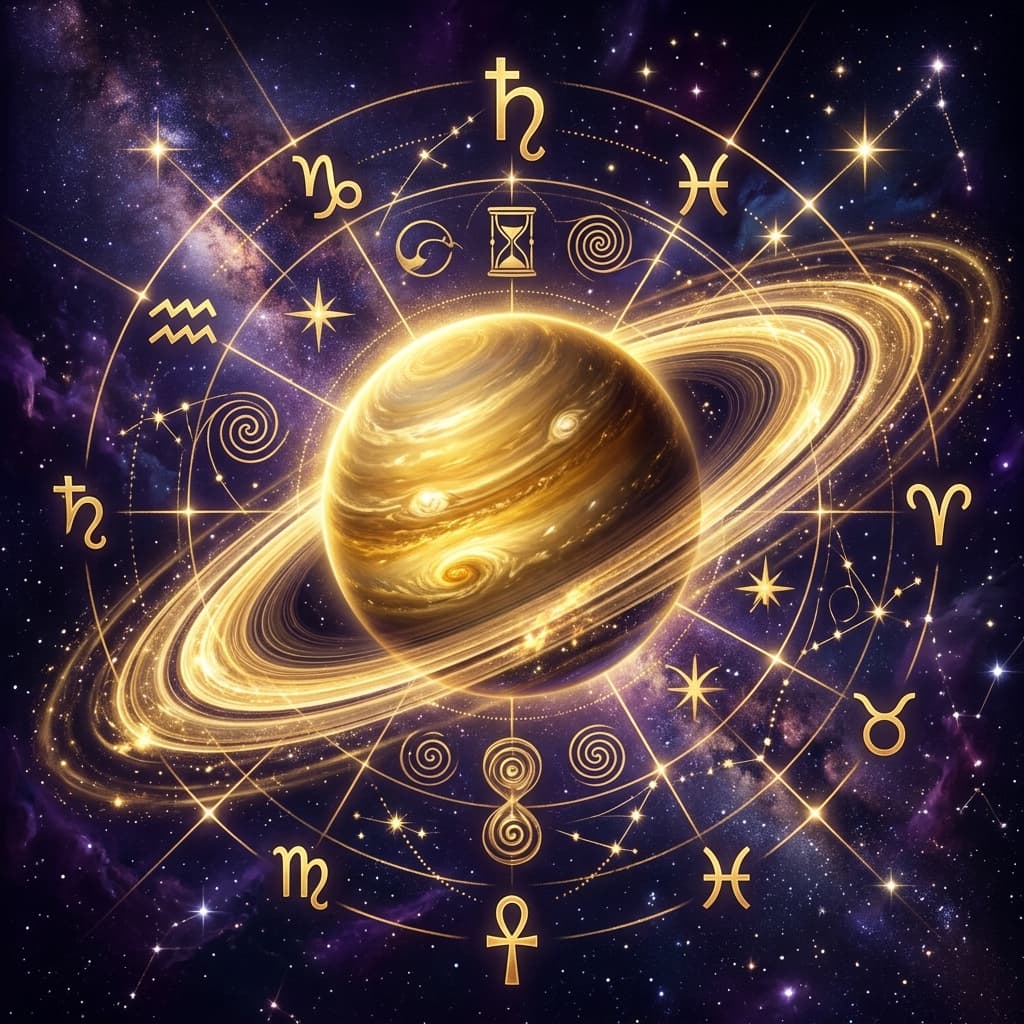
A Saturn return is when Saturn comes back to the position it held in your Birth Chart, roughly 29.5 years later. For most people the first one falls between ages 28 and 30. Because Saturn goes retrograde, it often crosses that degree three times, so the return is a period of about a year, not a single day.
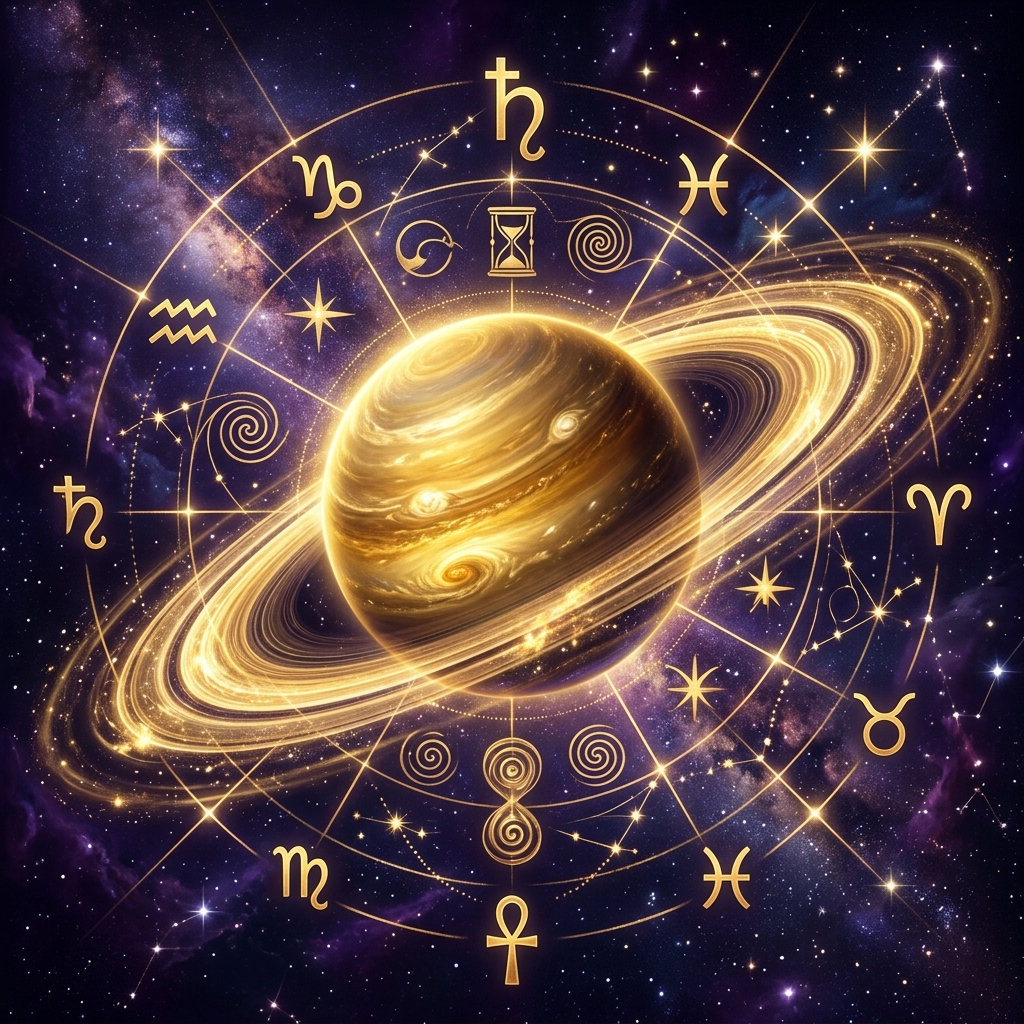
This guide treats astrology as entertainment and a framework for reflection; Saturn return readings are no substitute for health, legal or financial decisions.
Why does Saturn return after about 29.5 years?
Saturn takes about 29.5 years to orbit the Sun. Covering the twelve signs of the zodiac in that time, it spends around two and a half years in each sign. At the moment you were born, Saturn sat at a specific degree of a specific sign; about 29.5 years later it reaches that point again. Astrology calls this the Saturn return, and it usually happens twice in a lifetime, three times for those who live long. For a short definition, see the Saturn return glossary entry; this guide goes further into how the cycle works, the three passes and where to look in your own chart.
In astrology Saturn is linked to responsibility, limits, time, effort and structure. Its return to the natal position is therefore read as a kind of audit of the life you have built: what is solid, and what stands only out of habit, becomes visible.
| Return | Approximate age | Theme stressed in the tradition |
|---|---|---|
| First Saturn return | 28-30 | The real passage into adulthood, moving from other people's rules to your own |
| Second Saturn return | 57-60 | Maturity, harvesting your efforts, deciding what to carry and what to put down |
| Third Saturn return | 86-89 | Reviewing a life, passing on what you have learned |
The age ranges shift by a few months from person to person, because Saturn's speed varies along its orbit and its retrograde periods fall on different dates each year.
Why does Saturn cross your natal degree three times?
For about four and a half months each year, Saturn appears to move backward in the sky. This apparent backward motion is called retrograde; it is a viewing effect that occurs as Earth overtakes the slower-moving Saturn in its orbit. If your natal degree falls inside this back-and-forth loop, Saturn crosses it three times:
- Moving direct, Saturn reaches your natal degree for the first time.
- A few months later it turns retrograde, moves back and crosses the same degree a second time.
- When the retrograde ends and it moves direct again, it crosses the degree a third and final time.
If the degree lies outside that loop, there may be only one crossing. The three passes usually spread over close to a year, and some astrologers treat Saturn's whole two and a half years in the sign as the return period.
How are the three passes interpreted?
In the astrological tradition, the three passes are read as three stages of one process. At the first pass a theme opens up: a question about work, a relationship, home or daily structure becomes too clear to ignore. The second pass, during the retrograde, is the review stage; first reactions are questioned, missing information is filled in, and sometimes a step back is taken to think again. The third pass, when Saturn moves forward once more, is seen as the stage of decision and settling: the chosen path becomes clear and the foundation of a new structure is laid. This reading lets you see the Saturn return not as a single shocking event but as a process of maturing spread over about a year. In practice, knowing the dates of the three passes shows which months may feel more intense and helps you avoid rushing big decisions. You can find the dates from the Saturn degree in your Birth Chart using an ephemeris or a chart calculator.
Which area of your chart does a Saturn return touch?
A Saturn return does not bring the same theme to everyone. A reading looks at three things: the house Saturn occupies in your Birth Chart, Saturn's sign and the houses Saturn rules. The house matters most, because it shows which area of life is being tested. The sign describes the style in which that test unfolds.
- Saturn in the 10th house: career, title and public standing. A time when professional direction is questioned or a solid step is built.
- Saturn in the 7th house: marriage, partnership and commitment. Relationships become serious or are redefined.
- Saturn in the 4th house: home, family and roots. Moving, setting up a home or reshaping family ties.
- Saturn in the 2nd house: money habits and self-worth. Learning to manage your own resources.
You need your birth time to find Saturn's house; without it you can only know its sign. Create your chart on the birth chart page to see Saturn's house and sign, and read what a natal chart describes in the glossary.
Who is having a Saturn return in 2026-2028?
To make this concrete: Saturn is moving through Aries from February 2026 until spring 2028. Its previous stay in Aries ran roughly from April 1996 to March 1999. That means most people born in that window are having their first Saturn return between 2026 and 2028; Saturn briefly moved into Taurus for a few months in 1998, so people born then have slightly different timing. Saturn's stay in Aries before that ran roughly from March 1967 to April 1969, so people born in those years are having their second Saturn return in the same period. Not everyone in this group begins at the same moment: those with Saturn early in Aries feel it sooner, those with Saturn late in the sign feel it later. And because the house depends on birth time, two friends born the same year may live this period mainly through work for one and through relationships for the other. Checking your own Saturn degree is the best way to find your dates.
What are the most common myths about the Saturn return?
- "A Saturn return always brings crisis or a breakup." The traditional emphasis is on structure, not destruction. Something that no longer works may be questioned, but what you have worked for also settles on solid ground.
- "It starts on your 29th birthday." The return depends on the date Saturn reaches your natal degree, which does not line up with your birthday and usually falls somewhere between 28 and 30.
- "Everyone the same age goes through the same thing." Saturn's house and the houses it rules differ from person to person, so the area where the return is felt differs too.
- "It is just another name for the turning-thirty slump." Turning thirty is a cultural milestone; in astrology the Saturn return is tied to a specific cycle in the sky and includes the second and third returns as well.
How can you prepare for a Saturn return?
The astrological tradition frames the Saturn return as a time for taking stock rather than a reckoning. A few questions make a good frame for reflection: Which responsibilities did I really choose, and which did I simply inherit? Which habit or relationship no longer carries me? What is the one area where I want to lay a solid foundation for the next ten years? The answers are not in any planet's hands; astrology only offers a time frame for asking the questions. For the wider sky picture, the horoscopes page offers general readings, but only your own Birth Chart can show the timing of your Saturn return.
