
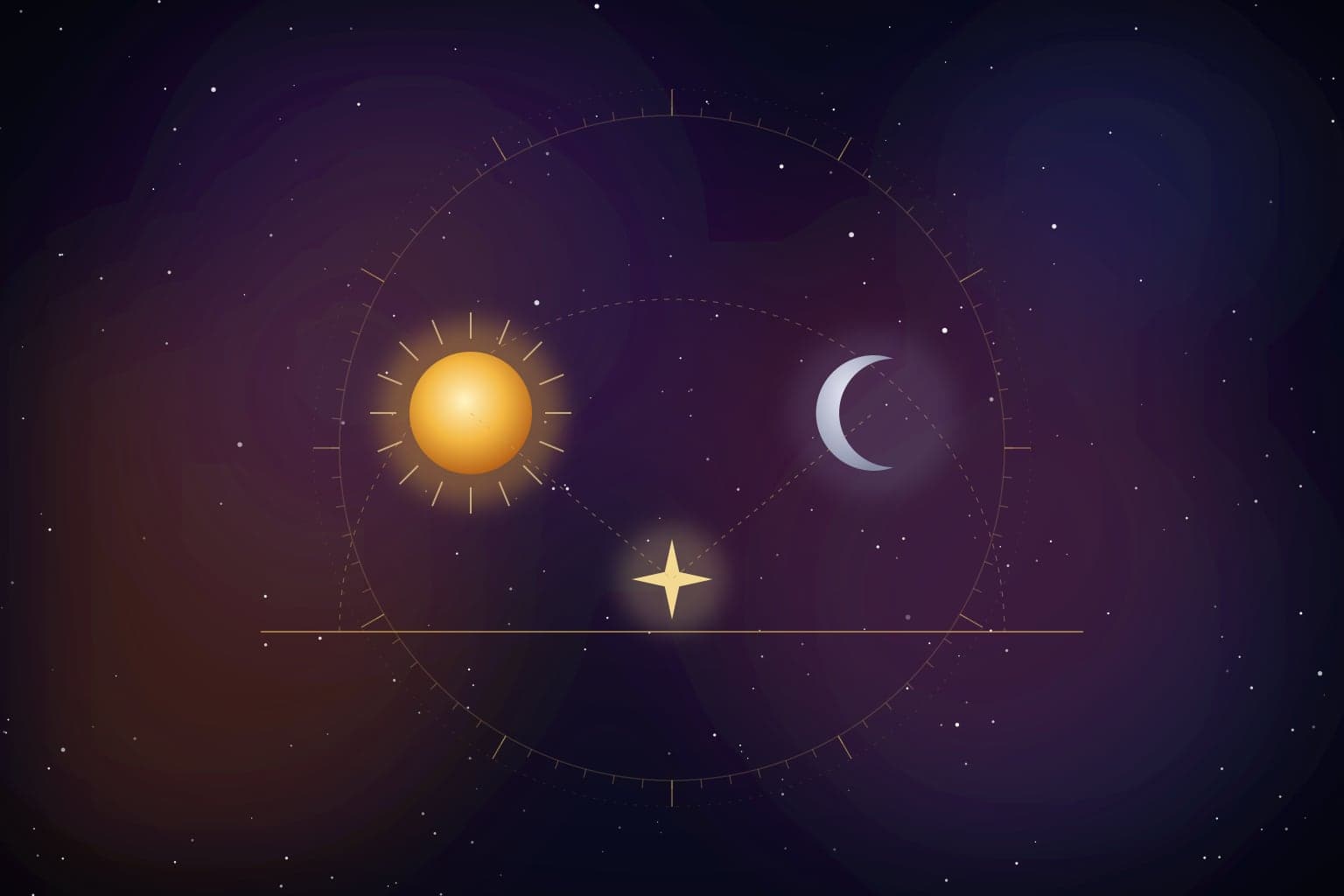
Big three astrology means reading your Sun, Moon and rising sign together. The Sun describes your core identity and will, the Moon your emotional needs and sense of safety, and the rising sign (Ascendant) your outward style and first impression. To find all three you need your birth date, exact birth time and birthplace.
Most people know only their Sun sign, the one printed next to horoscope columns. That is a twelfth of the story told twelve ways. This guide explains what each of the three placements describes, why the Moon and rising sign depend on the clock, how to blend them into one portrait, and where to go once the big three feel familiar.
What is the big three in astrology?
The big three is a shorthand for the three most personal points in a natal chart: the Sun sign, the Moon sign and the rising sign. Together they answer three different questions. Who am I trying to become? What do I need to feel safe? How do I meet the world?
Each point moves at a very different speed, which is why two people born on the same day can share a Sun sign and still read very differently. The Sun spends about 30 days in each sign, the Moon a little over two days, and the rising sign around two hours on average. So the Sun is shared with roughly one person in twelve, the Sun and Moon pairing is rarer, and the full combination narrows down to people born within a few hours of you in a similar place.
Astrologers still read the whole chart, including the planets and houses. The big three is simply the most useful first layer.
What do the Sun, Moon and rising sign each describe?
A helpful way to hold them apart is to think of three layers of the same person. The Sun is the engine, the Moon is the inner room you retreat to, and the rising sign is the front door other people walk through first.
Sun sign: core identity and will
The Sun shows what you are building over a lifetime: your sense of purpose, the way you use willpower and the qualities that make you feel most alive. It is the part of you that grows stronger when you act with intention. A Sagittarius Sun, for example, tends to come alive through learning, travel and big questions.
Moon sign: emotional needs and security
The Moon describes your reflexes rather than your goals. It shows how you react under stress, what comforts you, what you needed as a child and what you still need from a partner or a home. People often recognise their Moon sign more in private moments than in public ones.
Rising sign: outward style and the start of the houses
The rising sign, or ascendant, is the zodiac sign that was rising on the eastern horizon at the minute and place of your birth. It colours your manner, your body language and the first impression you give. It also sets the starting point of the 12 houses, so it decides which life areas each sign and planet falls into. Our guide to the rising sign goes deeper into this single placement.
The planet that rules your rising sign is traditionally called the chart ruler. With Libra rising it is Venus, with Capricorn rising Saturn. The sign and house of that planet show where the style of your rising sign flows in daily life.
| Sun | Moon | Rising sign | |
|---|---|---|---|
| Core question | Who am I becoming? | What do I need to feel safe? | How do I meet the world? |
| Shows up as | Purpose, willpower, vitality | Moods, habits, comfort needs | Manner, style, first impression |
| Time in one sign | About 30 days | About 2 to 2.5 days | About 2 hours on average |
| What you need to find it | Birth date | Birth date, usually birth time | Exact birth time and birthplace |
Why do you need your exact birth time for the big three?
Your Sun sign only needs a date because the Sun moves about one degree a day and stays in each sign for roughly a month. The Moon and the rising sign move far faster, so the clock matters.
The Moon circles the zodiac in about 27.3 days. It travels roughly 12 to 15 degrees a day and stays in one sign for about two to two and a half days. If you were born on a day when the Moon changed sign, the hour decides which of two Moon signs you have.
The rising sign moves faster still. Because Earth turns once a day, all 12 signs pass over the eastern horizon in about 24 hours, so the Ascendant changes sign every two hours on average, or about one degree every four minutes. Latitude stretches and squeezes this. Near 40 degrees north, the latitude of Madrid or New York, Aries and Pisces rise in about 70 minutes while Leo through Scorpio take about two and a half hours. Near 60 degrees north, around Tallinn, Aries can rise in about half an hour. A birth time that is 20 minutes off can therefore change your rising sign.
What happens if you don't know your birth time?
You can still read your Sun sign with confidence and, on most days, your Moon sign too. What you lose is the rising sign and the house positions, because both depend on the exact minute.
Before settling for an estimate, try these sources:
- Your full birth certificate or the long-form hospital record, which in many countries lists the time.
- A parent, older relative or family friend who remembers the morning, afternoon or night.
- A baby book, birth announcement, early photo or letter written around the day.
- The civil registry office in your birthplace, where records are kept.
If nothing turns up, a noon chart is the usual compromise. When the time is left blank in a Faltastik astrology reading, noon is assumed. That keeps the Moon within about six to seven and a half degrees of its true position, half a day of its motion, so your Moon sign is reliable unless the Moon sits near the edge of a sign that day. The rising sign and houses in a noon chart are placeholders, not answers, so treat them as unknown.
How do you find your Sun, Moon and rising sign?
Finding your big three takes a few minutes once you have the details. The calculation itself is astronomy: it compares the positions of the Sun and Moon with the zodiac and works out which degree was rising over your birthplace at that moment.
- Write down your birth date, the most exact birth time you can find and the town or city where you were born.
- Read the birth chart basics, then enter them in an astrology reading. The place matters because it sets your latitude, longitude and the time zone in force that day, including any daylight saving shift.
- Read off three lines: the sign of the Sun, the sign of the Moon and the sign on the Ascendant (often labelled ASC or the first house cusp).
- Note the element and modality of each sign using the table below. You will need them to combine the three.
Pay special attention to the time zone. Many countries have changed their clock rules over the decades, and a summer birth recorded under daylight saving time is an hour different from standard time. That single hour moves the rising degree by roughly half a sign to a whole sign, often enough to change the rising sign, which is why the place you enter matters as much as the time.
Faltastik's astrology reading uses your date, time and place to calculate the Sun, Moon, Mercury, Venus, Mars, Jupiter, Saturn, Uranus, Neptune and Pluto, plus the Ascendant and all 12 houses, then walks through your own chart rather than a generic Sun sign text.
What do Sun, Moon and rising signs mean for all 12 signs?
The same sign speaks with a different voice depending on where it sits. As a Sun it describes a goal, as a Moon a need, and as a rising sign a style. Use this table as a starting vocabulary, then see the zodiac sign pages for each sign in depth.
| Sign (Sun dates) | Element, modality | As your Sun | As your Moon | As your rising sign |
|---|---|---|---|---|
| Aries (Mar 21 - Apr 19) | Fire, cardinal | Courage, initiative, wanting to be first | Needs action and room to vent quickly | Direct, energetic, quick to move |
| Taurus (Apr 20 - May 20) | Earth, fixed | Steadiness, loyalty, building value | Needs comfort, routine and physical ease | Calm, grounded, unhurried |
| Gemini (May 21 - Jun 20) | Air, mutable | Curiosity, wit, making connections | Needs to talk feelings through | Chatty, alert, youthful |
| Cancer (Jun 21 - Jul 22) | Water, cardinal | Care, protection, belonging | Needs a safe home base and closeness | Soft, watchful, warm once trusted |
| Leo (Jul 23 - Aug 22) | Fire, fixed | Creativity, pride, generous presence | Needs to feel seen and appreciated | Confident, warm, noticeable |
| Virgo (Aug 23 - Sep 22) | Earth, mutable | Skill, service, getting it right | Needs order and something useful to do | Neat, modest, observant |
| Libra (Sep 23 - Oct 22) | Air, cardinal | Fairness, partnership, harmony | Needs peace and a calm partner | Charming, polite, easy to approach |
| Scorpio (Oct 23 - Nov 21) | Water, fixed | Depth, intensity, transformation | Needs trust, privacy and emotional honesty | Magnetic, reserved, hard to read |
| Sagittarius (Nov 22 - Dec 21) | Fire, mutable | Meaning, freedom, exploration | Needs space, humour and a horizon | Open, upbeat, restless |
| Capricorn (Dec 22 - Jan 19) | Earth, cardinal | Ambition, duty, long-term goals | Needs control and proof of progress | Composed, serious, capable |
| Aquarius (Jan 20 - Feb 18) | Air, fixed | Independence, ideas, community | Needs autonomy and emotional breathing room | Friendly but detached, unusual |
| Pisces (Feb 19 - Mar 20) | Water, mutable | Imagination, empathy, surrender | Needs quiet time and creative escape | Gentle, dreamy, adaptable |
Dates for the Sun shift by a day in some years, because the calendar and the solar year do not line up exactly. If you were born on one of the boundary days, check your chart rather than a list.
How do you combine your Sun, Moon and rising sign?
Reading the big three is less about adding three descriptions and more about seeing how they cooperate. Two tools do most of the work: the elements (fire, earth, air, water) and the modalities (cardinal, fixed, mutable).
- Start with the Sun as the main theme. Name it in one sentence: what does this person want to grow into?
- Ask whether the Moon supports or questions that theme. Fire and air tend to feed each other, as do earth and water. Fire with water, or air with earth, often means the head wants one thing and the heart another.
- Treat the rising sign as the delivery. It explains how the Sun and Moon are presented, and why people may misjudge you at first.
- Compare the modalities. Three fixed signs suggest persistence and stubbornness, three mutable signs flexibility and scattered focus, three cardinal signs a starter who may leave finishing to others.
- Look for repetition. When two of the three share a sign or element, that note gets louder. When all three differ, the person often shows different faces in different settings.
| Element pairing | Typical effect |
|---|---|
| Same element (for example fire and fire) | The theme gets louder but can become one-sided |
| Fire and air | Mutually feeding: ideas and enthusiasm |
| Earth and water | Mutually feeding: trust and continuity |
| Fire with water or earth | Friction between speed and sensitivity or patience |
| Air with water or earth | Tug of war between thinking and feeling or practical needs |
The Sun and Moon pairing also reveals the lunar phase you were born under. If they share a sign, you were born near a new Moon; if they sit in opposite signs, near a full Moon. New Moon births are often read as single-minded and inward, full Moon births as a lifelong balancing act between two poles.
Tension is not a flaw. A mixed big three usually describes someone with more range, who simply needs to learn when each part should lead.
Example 1: Leo Sun, Sagittarius Moon, Aries rising
All three are fire signs, so the picture is strongly consistent: warmth, enthusiasm and a need to act on ideas quickly. Aries rising makes the first impression direct and energetic, the Leo Sun wants to create something that carries its name, and the Sagittarius Moon recharges through freedom and new experiences. The challenge with a single-element big three is balance. Patience, rest and other people's slower feelings may need conscious effort, and the rest of the chart shows where that grounding might come from.
Example 2: Capricorn Sun, Cancer Moon, Gemini rising
Capricorn and Cancer are opposite signs, which means this person was born in the days around a full Moon. Both are cardinal, earth and water are compatible elements, yet the axis pulls between career and home, duty and tenderness. Gemini rising adds a light, talkative surface, so others may see a quick, sociable person and miss both the quiet ambition and the deep need for family. Understanding often begins when the person stops treating work and private life as rivals.
Example 3: Aquarius Sun, Taurus Moon, Scorpio rising
Here all three signs are fixed, and by sign they form a T-square: Aquarius squares Taurus and Scorpio, while Taurus and Scorpio sit opposite each other. Expect strong loyalty, firm opinions and a reluctance to change course under pressure. The Aquarius Sun reaches for ideas and independence, the Taurus Moon wants stability and physical comfort, and Scorpio rising gives an intense, private presence that people remember. The growth edge is flexibility, and the gift is staying power.
Why don't I feel like my Sun sign?
The most common complaint about astrology, "I am nothing like my sign", usually has a simple explanation. A Sun sign describes one layer of a chart, and several things can push it into the background. A strong Moon or rising sign is the most frequent reason, especially when the rising sign's ruling planet sits prominently in the chart. Planets clustered in another sign, known as a stellium, can also outweigh a lone Sun. Being born near a sign boundary matters too, and some astrologers read a Sun at 29 or 0 degrees as carrying a flavour of the neighbouring sign. Western astrology also uses the tropical zodiac, which is tied to the seasons and begins at the March equinox, so your sign is not the constellation behind the Sun today; precession has shifted the two by about 24 degrees. Finally, newspaper horoscopes are written for twelve groups at once, so they rarely capture any single person well.
What comes after the big three in a Birth Chart?
Once your Sun, Moon and rising sign feel familiar, the next layer is the inner or personal planets: Mercury, Venus and Mars. They move fast enough to differ between people born a few weeks apart, and they describe everyday behaviour in more detail than the big three can.
- Mercury shows how you think, learn and talk. It is never more than about 28 degrees from the Sun, so it sits in your Sun sign or one of the two neighbouring signs.
- Venus describes how you love, what you find beautiful and how you relate to pleasure and money. It never strays more than about 47 degrees from the Sun. Read more in what your Venus sign says about your love style.
- Mars shows how you pursue goals, handle anger and express desire. It moves independently of the Sun and can be in any sign. See what your Mars sign means for drive and desire.
After the personal planets come the houses, which show where in life each energy plays out, and the aspects, the angles between planets that show which parts of you work together and which argue.
Which advanced topics build on the big three?
Several popular techniques assume you already know your natal chart. Each one adds a narrower lens rather than replacing the basics.
- Solar return: a chart cast for the moment the Sun returns to its exact birth position each year, read as a theme for the year ahead. See how a solar return chart works.
- Black Moon Lilith: a calculated point in the Moon's orbit, linked to what we suppress or refuse to tame. See Black Moon Lilith in astrology.
- Chiron: a small body orbiting between Saturn and Uranus, read as a sensitive spot that can turn into a way of helping others. See Chiron, the wounded healer.
Faltastik does not calculate the solar return, Lilith or Chiron. For those, an ephemeris or dedicated chart software gives the positions, and your natal big three remains the frame you read them against.
What should you do next with your big three?
Find your exact birth time first, even if it takes a phone call. Then calculate your chart and write your big three as one sentence: "a [Sun] who needs [Moon] and comes across as [rising]". That sentence is a working hypothesis, not a verdict, so test it against moments you remember and adjust it as you learn more.
Three questions help:
- When I chase a goal, which part of me is driving, the Sun or the rising sign?
- What comforts me most when I am tired or hurt, and does it match my Moon sign?
- What do people get wrong about me when they first meet me?
Noting your answers for a few weeks teaches more than memorising sign descriptions.
When you want a fuller reading of your own placements, start with your Birth Chart and then ask the astrology reading the question on your mind. Astrology here is offered for self-reflection and entertainment; it is not medical, legal, financial or psychological advice, and the decisions remain yours.
