
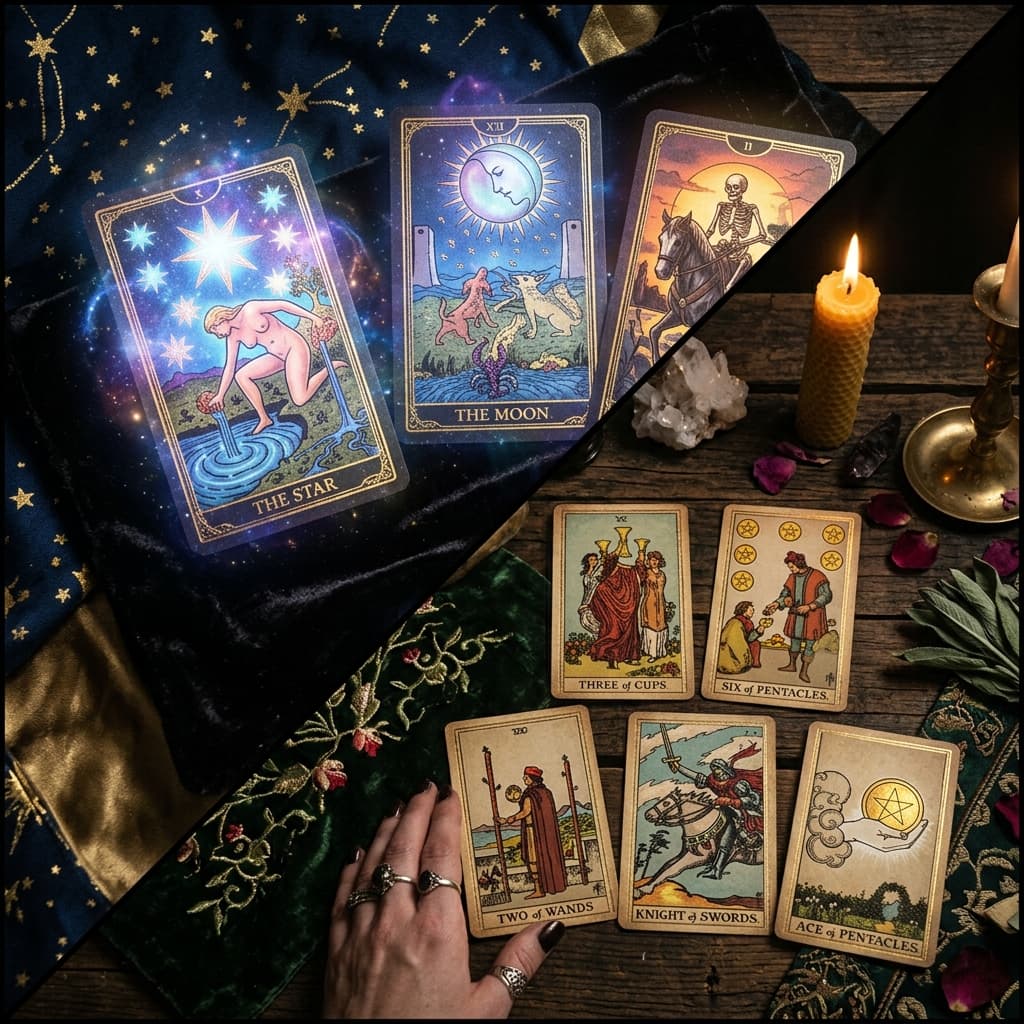
TL;DR: Every card in a tarot deck has a dictionary meaning, but the real reading begins when cards land side by side. Two cards drawn together can soften each other's meaning, sharpen it, or turn it in an entirely new direction. Traditional combination reading rests on three principles: the interaction of the cards' elements, the difference in weight between the Major and Minor Arcana, and the emphasis of repeating or consecutive numbers. This guide walks through ten example pairs to show how cards touch one another, and how a reversed card changes a combination.
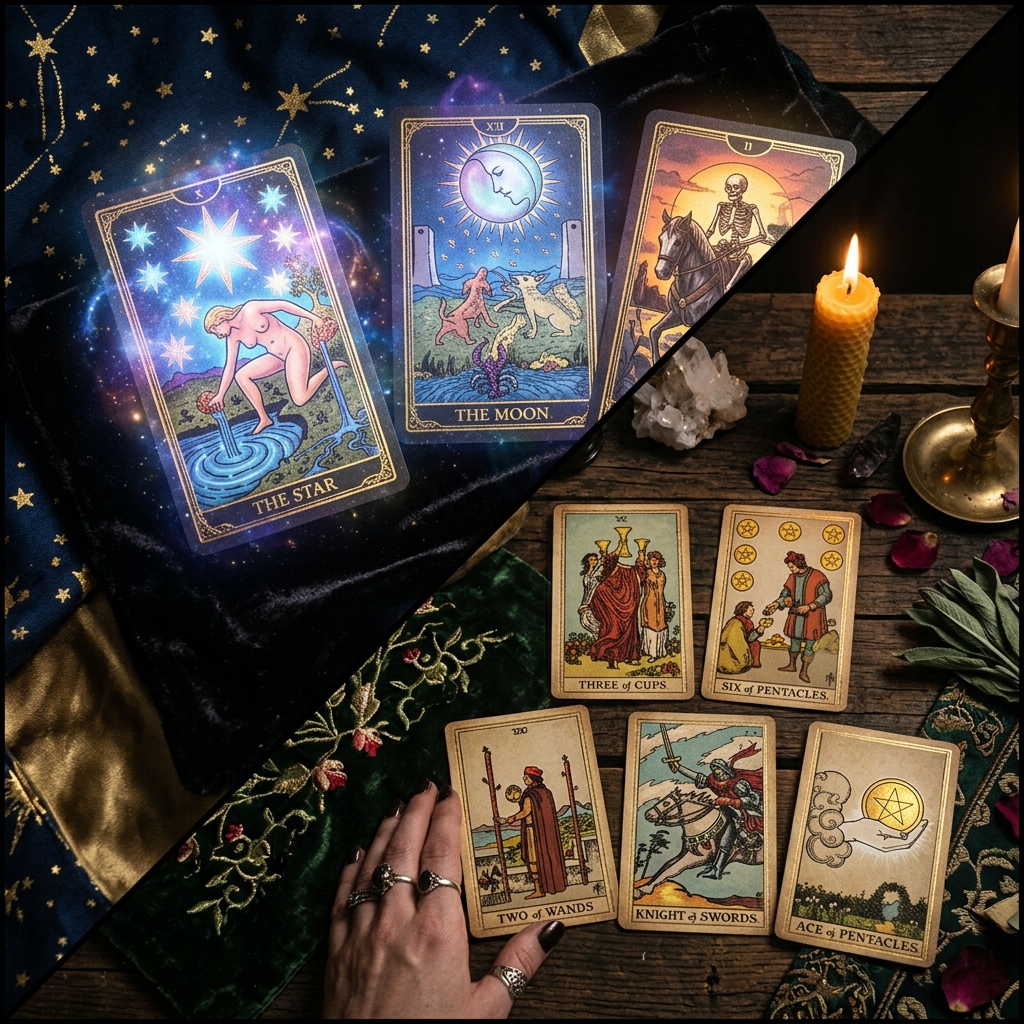
Cards Build Sentences
A single card is like a word: it has a meaning but no context. When two cards come together, a subject and a verb appear, and a sentence forms. The Two of Cups on its own speaks of mutual love and a balanced bond; when the Tower lands beside it, the same bond is read as about to be tested by a jarring truth. The card is the same; the sentence has changed.
This is why practiced readers see cards together, not one after another. First comes the overall weather of the spread: is light or shadow heavier on the table? Then the bridges between pairs are built. This article is about that way cards touch one another; if you are wondering which layout to use and how many cards to draw, our guide to tarot spreads takes up that question separately.
Element Interactions: The Chemistry of the Cards
The four suits of the Minor Arcana are tied to the four elements: Wands to fire, Cups to water, Swords to air, Pentacles to earth. The Major cards have traditional element pairings as well; the Devil leans toward earth, the Star toward air, the Moon toward water. When two cards' elements feed each other, their meanings amplify one another; when they clash, the reading is built on tension.
Fire and air stoke each other: a Sword beside a Wand card turns idea into action and action into speed. Water and earth hold each other: when a Cup and a Pentacle sit side by side, feeling takes solid form and the relationship settles onto safe ground. Fire and water, however, put each other out; when they land together, tradition reads it as a loss of momentum, enthusiasm snagging on emotion or emotion being rushed. Earth and air are indifferent to each other: plan and practice share the table but speak different languages, and a theme of disconnection enters the reading. Two cards of the same element deepen the emphasis; two Cups cards double the emotional agenda, two Swords the mental intensity.
Major and Minor: Who Is Speaking at the Table?
Two cards never speak with equal weight. The Major Arcana names the great chapters of a life; the Minor Arcana shows the everyday scene of that chapter. In a pair with one Major and one Minor, the Major sets the subject and the Minor shows how it is being lived. The Eight of Pentacles beside Death says that a great closing is moving hand in hand with a process of mastery at work; Death holds the lead role, and the Eight of Pentacles builds the stage.
When two Majors land together, the tone of the reading deepens: the matter is less about personal choices than about the current of life itself. Two Minors give an everyday snapshot; the details inside the scene should be read without inflating their meaning.
Repeating Numbers and Sequences
The most overlooked layer of combination reading is the numbers. Two cards of the same number nail that number's theme to the table: two fives say that friction and a sense of loss are running high for a season, while two aces announce two new doors opening at once. Consecutive numbers show a process in motion; a Four beside a Three says a budding venture has entered its consolidation phase. When the numbers run from high to low, tradition reads it as rewinding, a need to take a matter up again from the beginning.
Example Combinations: Three Classic Pairs Up Close
The Lovers with the Devil is the textbook case of combination logic. Both cards speak of forming bonds, but one by choosing and the other by staying bound. When they land side by side, tradition reads a pull that is powerfully attractive yet narrows freedom: the voice of the heart and the gravity of habit have met in the same person or the same situation. The question is not which is stronger, but whose hands the choice is still in.
The Tower with the Star is the storm and its aftermath. On its own the Tower describes a jarring collapse, but the Star beside it brings to the table the healing that follows and a clear, quiet hope. This pair is the established sign of hard news opening, in the long run, onto a refreshing rebuilding.
Death with the Sun tells a similar story of transformation: behind the closing door there is light. What Death ends is read, thanks to the Sun, not as a loss but together with the bright new season it makes room for. Had the same Death card appeared beside the Moon, the reading would drift toward uncertainty and prolonged mourning; the second card chooses which face of the first will speak.
The table below gathers these three together with ten frequently asked pairs and their traditional readings.
| Combination | Shared Theme | Traditional Reading |
|---|---|---|
| The Lovers + The Devil | Choice and attachment | A bond of strong attraction that narrows freedom; a warning to keep the power of choice |
| The Tower + The Star | Collapse and hope | Healing after the shock; hard news opening onto rebuilding |
| Death + The Sun | Ending and birth | Light behind the closing door; a farewell turning into a bright beginning |
| The Magician + Ace of Cups | Intention and feeling | A new bond or inspiration begun with awareness; joining heart to the tools at hand |
| The Empress + Ten of Pentacles | Abundance and permanence | Home, family, and material security growing together; effort taking root |
| The Moon + Two of Swords | Uncertainty and decision | A warning not to choose before the fog lifts; postponement becoming protection for now |
| The Hermit + The World | Withdrawal and completion | The ripe fruit of a solitary search; an era closing quietly and whole |
| Justice + Ace of Swords | Balance and clarity | Truth coming to light; plain speech restoring balance in formal matters |
| Strength + Five of Wands | Patience and rivalry | Managing friction with soft power; calm restraint instead of brute force |
| The High Priestess + Eight of Cups | Intuition and departure | Consulting the inner voice and changing course; leaving at the right time, even if misunderstood |
These readings are a traditional frame, not a set of molds. The same pair speaks one way in a love question and another in a work question; the final word on a combination always belongs to the context of the question.
How Does a Reversed Card Change a Combination?
A reversed card does not cancel a meaning; it turns the energy inward, delays it, or pushes it to excess. When one card of a pair falls reversed, the weight shifts in favor of the upright card, and the reversed one shows the stumbling side of the story. A reversed Tower with an upright Star says the shock was weathered lightly and hope has come out on top. An upright Lovers with a reversed Devil is the most open version of that pair: a threshold where the dependency is loosening and the power of choice is being won back.
When both cards fall reversed, the theme does not disappear; it stalls. The process the pair describes sits on the table but does not flow; tradition reads this as a matter not yet ripe, an inner preparation still underway. In such a spread, waiting and review are advised over a hasty verdict.
Three Common Mistakes
The first mistake is reading the cards one by one and averaging their meanings; a combination is not addition but a chemical reaction. The second is treating a frightening-looking card as a verdict in itself; even the Tower can speak of ruin or of rescue depending on the card beside it. The third is forgetting the question: the same pair opens onto different scenes in health, love, and work questions. In combination reading your compass is always the question that was asked.
Frequently Asked Questions
Can a meaningful reading be done with two cards?
Yes. A two-card reading is the best way to learn combination logic; two cards build a sentence, and for most everyday questions that sentence is enough. As the number of cards grows, sentences become paragraphs.
Which card carries more weight in a combination?
A Major speaks louder than a Minor, and an upright card louder than a reversed one. When two cards carry equal weight, the one closer to the question takes the lead and the other qualifies it.
Do you have to memorize every combination?
No; there are thousands of possible pairs and no list is ever complete. Instead of memorizing, apply the three principles: look at the chemistry of the elements, the Major-Minor balance, and the language of the numbers.
If you want to refresh the individual card meanings, have a look at our tarot guide, and to try the combination logic you have just learned on a question of your own, stop by a Faltastik tarot reading.

