
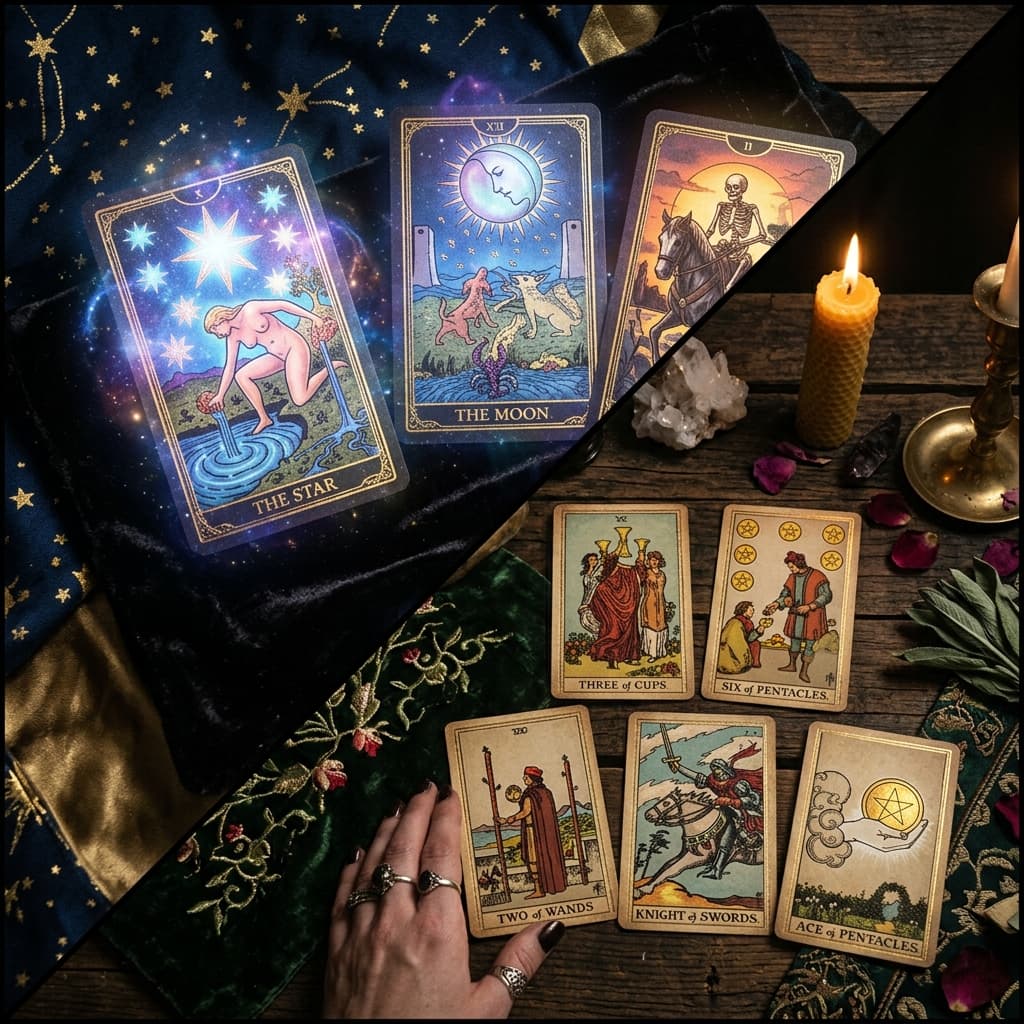
There is no single right answer to coffee cup reading versus tarot; it depends on the kind of question you have and the time you can give it. For a general check-in with the feel of a conversation, choose coffee. To think through one specific question step by step, choose tarot. Neither knows the future, and both invite reflection.
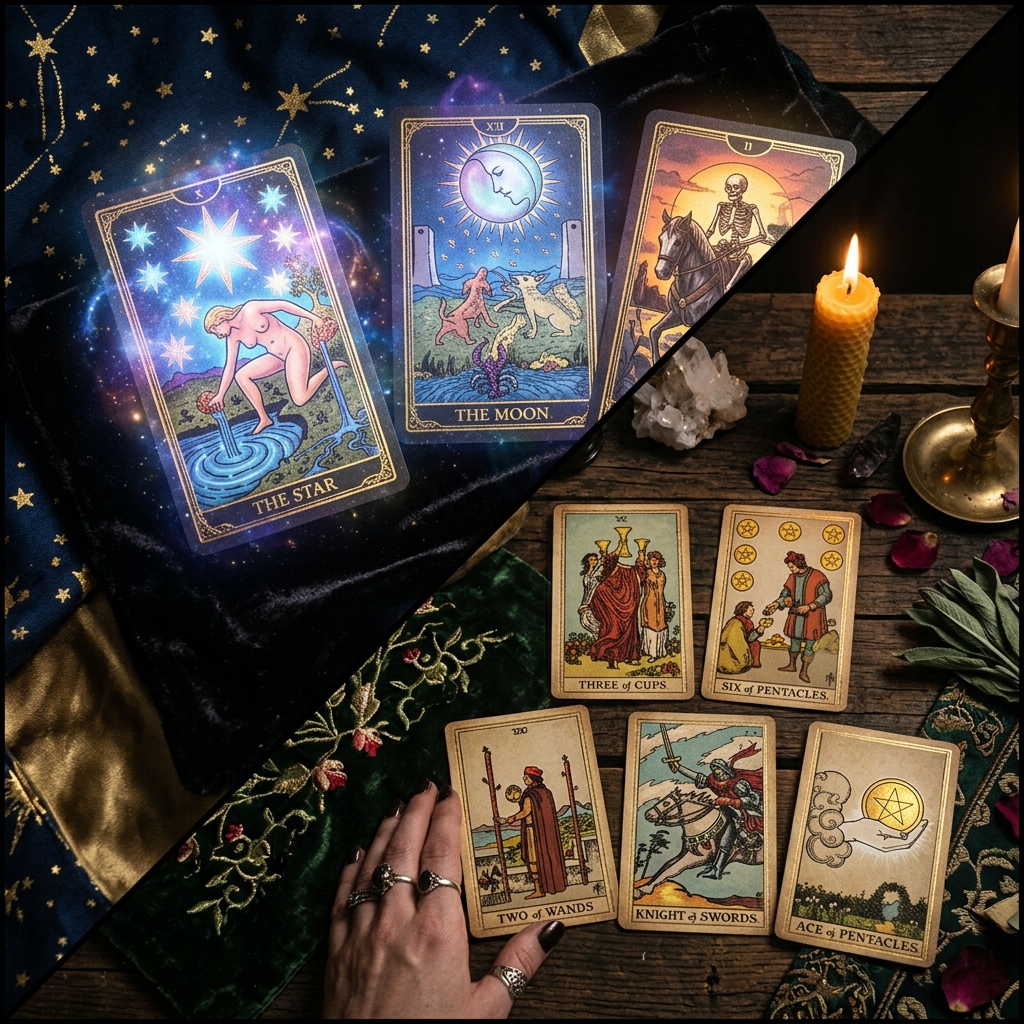
This article puts the two side by side: how they work, which questions they suit, how much preparation they need and what kind of reading you end up with. We do not rule on which one is "more accurate", because the two cannot be measured on the same scale.
What is the main difference between coffee cup reading and tarot?
The main difference is what the reading rests on. In coffee cup reading, the material is the shapes formed by the grounds as they run down the walls of the cup and onto the saucer. These shapes form anew, on their own, in every cup; the reader likens them to traditional symbols such as a bird, a road, a heart or a letter, and reads them by where they sit in the cup. The same smudge can look different to two people, so coffee reading leaves a lot of room for the reader's eye and storytelling.
In tarot, the material is fixed. A deck has seventy-eight cards: twenty-two Major Arcana and fifty-six Minor Arcana. Each card has an established meaning and is read according to the position it lands in within a spread. What changes is which cards come up and in what order. In short, coffee reading is like a free-form picture, while tarot is like a sentence whose words are known in advance. Both serve the same purpose: helping you look at your situation from another angle.
How do coffee cup reading and tarot compare side by side?
The table below compares the two methods under the same headings. The rows are not a ranking; they only show the differences.
| Heading | Coffee cup reading | Tarot |
|---|---|---|
| Question type | General direction, open questions such as "what is going on in my life?" | Focused questions about a specific topic, decision or relationship |
| Preparation | Turkish coffee is brewed and drunk, the cup is turned onto the saucer and left to rest | The question is clarified, a spread is chosen and cards are drawn |
| What you need | Turkish coffee, a cup and saucer; online, a photo of the cup | A tarot deck; online, only your question and card choice |
| Time | Longer, including brewing and drinking; the cup rests for five to ten minutes | Shorter; mostly set by how many cards the chosen spread uses |
| What it rests on | Shapes in the grounds that form anew each time | Seventy-eight cards with established meanings |
| What the result looks like | A narrative that moves around the areas of the cup like a story | A step-by-step reading where each card is tied to a position |
When does a coffee cup reading suit you best?
Coffee reading comes into its own when you are curious about your general state rather than one specific question. It works well for open questions such as "how will the coming period go?" or "what is on my mind?", because the cup shows you the shapes it chooses. The reading often flows like a story: a house by the handle, a road near the rim and a bird waiting at the bottom get linked together. In that sense a coffee reading is less like an answer to a question and more like a conversation.
Coffee reading also has a social side. Traditionally it happens after a cup of coffee among friends or family, and much of the pleasure lies in the talk around the reading rather than the reading itself. Turkish coffee culture and tradition were added to UNESCO's Representative List of the Intangible Cultural Heritage of Humanity in 2013. If you enjoy coffee, like the ritual and want to hear the result as a story, coffee reading will feel closer to you.
When does tarot suit you best?
Tarot is strongest when you have a clear question in mind. An open but focused question such as "what should I watch out for in this job offer?" works better than "should I take this job?". Each position in a spread matches one side of the question; a three-card spread, for example, shows the past, the present and the likely direction with separate cards, so the reading stays focused and moves step by step.
Another advantage of tarot is that it offers a repeatable language. Because the card meanings are established, over time you can start reading on your own. Once you learn that a card such as the Star is associated with hope and renewal, you will recognise it in every spread. It needs no preparation, so you can do a reading during a lunch break. If you want to break an undecided matter into parts, weigh the options one by one and clarify your own thinking, tarot will suit you better.
Which one gives more accurate results?
People ask this often, but the same answer applies to both: neither coffee reading nor tarot knows the future. Comparing their "accuracy" is like ranking two different kinds of book by which one is more correct. The real question is which one makes you think more and whose language feels closer to you.
That is why both should be used for entertainment and reflection; they are not a substitute for health, legal or financial advice. A good reading does not so much tell you something as get you to ask yourself a question.
Can you use both together?
Yes, and many people do. A common approach is to start with a coffee reading for the general picture and then open up the topic that stands out in the cup with tarot. If a road and a letter appeared in the cup, for example, you could explore "what might this journey or news be about?" with a three-card spread. The reverse also works: looking again with a cup of coffee the next day at something that stayed unclear in tarot.
The one thing to avoid is asking the same question again and again until you like the answer. Repeated questions feed anxiety more than insight. Using the two as complementary viewpoints lets you get more out of both. Setting your intention clearly at the start, what tradition calls intention setting, shapes the focus of the reading in either method.
How do coffee reading and tarot work on Faltastik?
For a coffee reading on Faltastik, you upload a photo of your cup, briefly describe what you see and add a question if you like. For a tarot reading, you first write your question or intention, then choose one of five spreads, from a single card to the Celtic Cross, and draw your cards; the spreads range from one to thirteen cards. To explore the traditional meanings behind each method, start with the coffee reading and tarot pages.
You can try each reading type once for free without an account, so you can try both and decide for yourself which feels closer. The free plan includes fifteen readings a month.
