
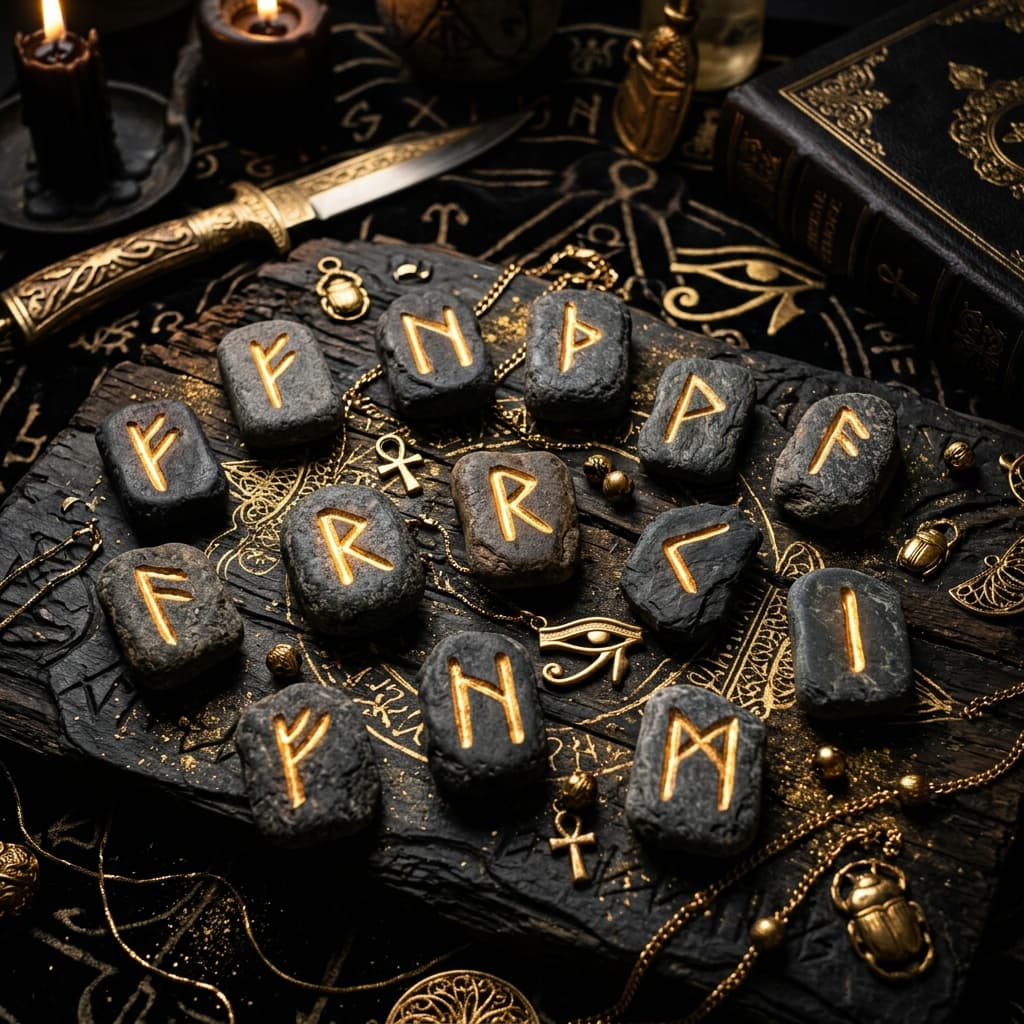
TL;DR: In rune reading, the spread is the frame that decides how the drawn stones are laid out and what each position will describe. The daily single-rune draw, the three-stone layout showing past and direction, and the five-stone spread surrounding a question from four sides are the three most established methods. A stone that lands upside down counts as a reversed rune and describes the shadowed, delayed, or inward form of its meaning; nine of the twenty-four runes are symmetrical and are never read reversed.
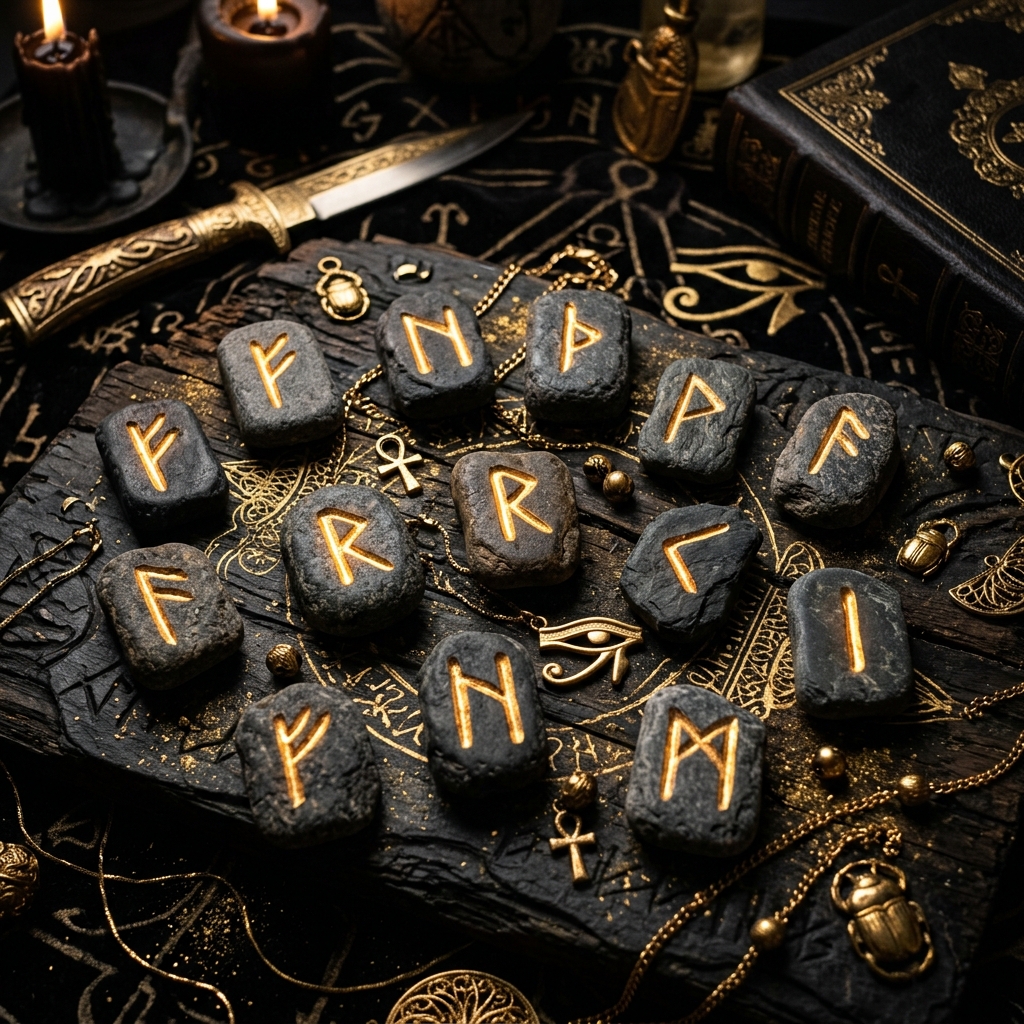
What Is a Spread, and Why Do You Need One?
Every stone in the runic alphabet has its own meaning, but meaning alone does not make a sentence. A spread gives the stones a syntax: before you draw, you decide which stone will describe the root of the matter, which the present, which the direction of travel. The same rune can describe a closed account in the "past" position and an approaching possibility in the "road ahead" position. Stones drawn without a spread are like words scattered at random across a page.
Settling the question before the draw is part of the spread as well. The runic tradition prefers situation questions to yes-or-no questions: instead of "Should I take this job?", asking "What kind of process will this job bring me?" suits the language of the stones far better. The stones are chosen by hand from the pouch without looking; you do not know which stone has come until you set it into its position.
The Single-Rune Draw: Stone of the Day
The plainest spread is a single stone. One rune drawn from the pouch in the morning gives the day a theme: draw Fehu and the day belongs to effort and earnings; draw Isa and it is a day not to hurry. The single draw is the best school for a beginner, because you live with the stone all day and watch how its meaning shows up in ordinary life. A single stone also serves for taking a quick signal on one clearly framed question.
The Three-Stone Spread: Root, Present, Road
The backbone of rune reading is the three-stone layout. The stones are set out left to right: the first describes the root of the matter and the influence arriving from the past, the middle stone the present situation, and the third the place the current course leads to if it continues. The third position is a tendency, not a verdict; the reading opens with "if things continue this way" and closes with "they may yet go another way."
The same threefold layout can be built around other questions: three stones laid out as situation, obstacle, and advice are especially loved for decision readings. It is enough to choose your pattern before the draw; the rule is never to change what a position means after the stone has landed.
The Five-Stone Spread: Surrounding the Question
For knottier matters, five stones are laid out in the shape of a cross. The center stone is the matter itself; the stone to its left describes the past, the one to its right the likely direction. The stone below shows the unseen foundation of the matter, the influence that works without being asked about; the stone above shows the best outcome within reach, or the attitude that should be taken. Five stones add depth to the three-stone timeline: the question is no longer only "what happened and what comes next," but also "what works underneath, and what is possible above."
What Is a Reversed Rune?
When the stones are drawn from the pouch and set down, some land upside down; that is a reversed rune. A reversed rune is not the meaning flipped into its opposite but the meaning shadowed: the energy is the same, yet it works delayed, turned inward, or blocked. Fehu, the stone of abundance, describes gain when upright; reversed, it speaks of waste, or of effort whose reward is late in coming. A reversed stone is not a punishment. It is a note that says "this force is not flowing freely right now."
There is one subtlety: not all twenty-four stones can be read reversed. Runes whose shape is symmetrical, such as Gebo, Hagalaz, Isa, Jera, Eihwaz, Sowilo, Ing, Dagaz, and Nauthiz, look the same upside down; tradition reads these stones only in their upright meaning. It is therefore perfectly normal for a spread to contain no reversed stones at all.
Common Reversed Rune Examples
| Rune | Upright Meaning | Reversed Reading |
|---|---|---|
| Fehu | Gain, abundance | Waste, a reward delayed |
| Uruz | Strength, endurance | Force spent in the wrong place, fatigue |
| Ansuz | News, inspiration, the word | Misunderstanding, communication cut off |
| Raidho | Journey, rhythm | A plan out of step, a road postponed |
| Kenaz | Illumination, mastery | Enthusiasm fading, a truth ignored |
| Wunjo | Joy, harmony | Shallow cheer, happiness deferred |
| Algiz | Protection, intuition | Left unguarded, a warning unheard |
| Tiwaz | Justice, resolve | An unjust fight, willpower going out |
A reversed stone is weighed together with the whole spread. If a reversed Raidho in the direction position stands next to an upright Jera, the reading closes as "delayed, but it ripens when its season comes"; magnifying a reversed stone on its own throws the spread off balance.
The Manners of the Reading
The runic tradition loves simplicity. The same question is not spread twice in a row; what the stones say first is the answer for that day. There is no hurrying while the stones are drawn, the positions are fixed in advance, and nothing changes after a stone has landed. Returning the stones to the pouch and mixing them at the end is both a practical and a symbolic close: the question was asked, the answer received, the ledger shut.
Frequently Asked Questions
How many stones should a beginner start with?
One. The daily single-rune draw teaches the meanings by living with them and builds the discipline of the spread; the three- and five-stone layouts come after.
Is a reversed rune always bad?
No. A reversed rune describes the shadowed or delayed form of a meaning; it is a warning. Read together with the other stones of the spread, it usually points the way.
Is the blank rune used?
The blank stone is an addition popularized by modern sets; it does not exist in the historical alphabet. Using it is a choice; traditional readers keep to the twenty-four stones.
For the meanings of the stones one by one, see our rune dictionary, and read the history of the alphabet in our rune reading guide. When you are ready to draw stones for a question of your own, Faltastik rune reading lays the spread out for you; for the overview, our rune reading page is always open.
