
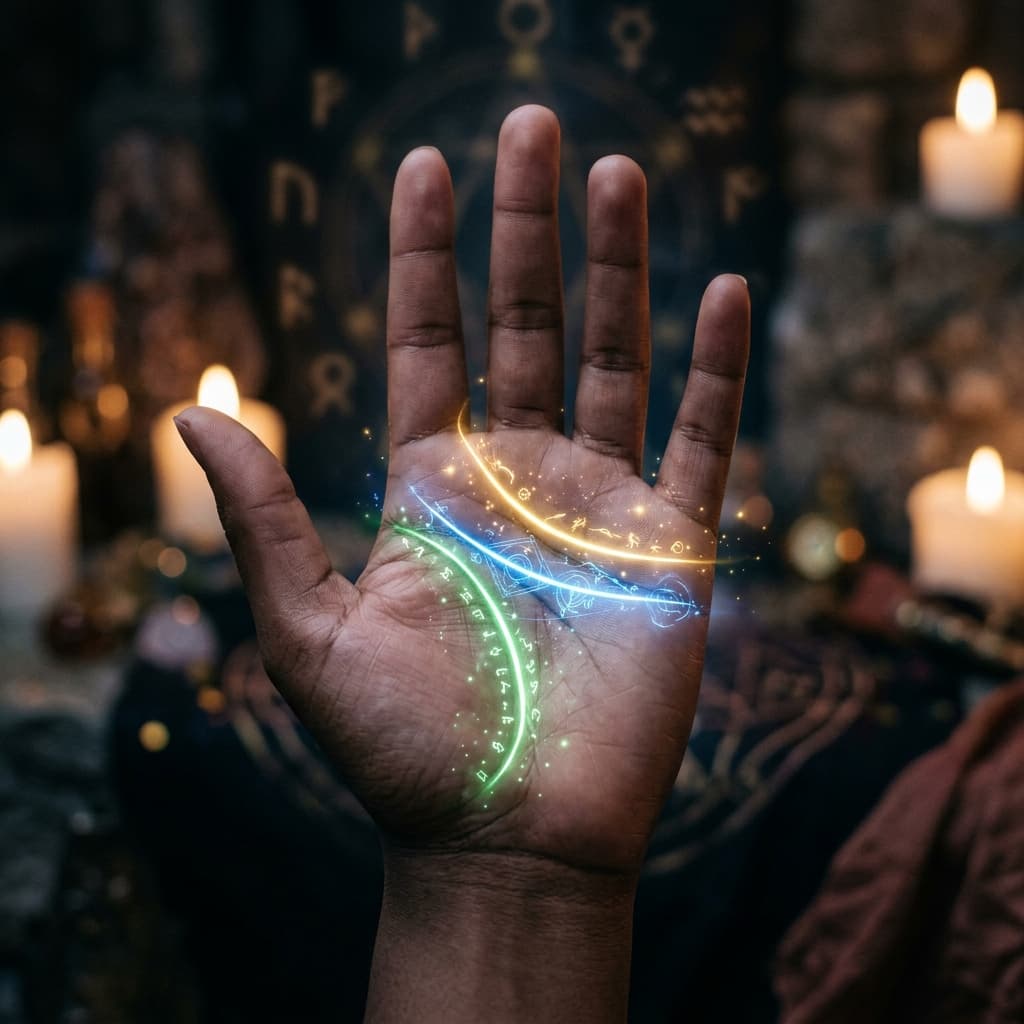
TL;DR: Palmistry reads the hand through four major lines. The life line curving around the thumb speaks of physical energy and the way life is lived; the heart line across the upper palm describes emotional makeup; the head line running through the middle shows the style of thinking; and the fate line rising vertically tells the story of work and responsibility. Depth, breaks, and the small marks along a line matter as much as its length.

Which Hand Do You Read First?
Tradition treats the two hands as two separate ledgers. The dominant hand, the one you write with, describes your conscious life and everything you have built with your own effort; the other hand is taken as a map of inborn tendencies and the inner world. A practiced reader therefore opens both palms side by side: lines that look alike in both hands point to a settled character, while lines that differ sharply suggest a life that has carried the person some distance from their native temperament.
It is also customary to take in the palm as a whole before reading anything. A hand with few, deep lines belongs to a nature that gathers its energy into a handful of matters; a hand covered in fine lines describes a sensitive temperament, open to every stimulus. A crowded palm is not a flaw. It is simply the hand's own handwriting.
The Life Line: The Route of Energy
The life line begins between the thumb and the index finger and sweeps in an arc around the fleshy mount of the thumb, the mount of Venus, down toward the wrist. Despite what its name suggests, it does not measure the length of a life; it describes how life energy is spent. A line that descends in a wide arc shows a nature that joins life with appetite, while a narrow arc hugging the thumb belongs to a cautious temperament that spends its energy sparingly.
A deep, unbroken life line is the sign of endurance. Breaks are read not as disasters but as changes of tempo: a move, a change of work, a period in which life is rebuilt. If a parallel line begins right beside the break, tradition calls it a "bridge"; the transition was crossed without a jolt. A second, inner line accompanying the life line, the line of Mars, counts as a protective support and a reserve of energy.
The Heart Line: The Measure of Feeling
The heart line runs along the upper palm, from beneath the little finger toward the other fingers. Where it ends is the key to the reading: a line reaching under the index finger, to the mount of Jupiter, describes an idealistic lover with high expectations; a line ending beneath the middle finger, a nature that values pleasure and tangible closeness over sentiment; a line ending between those two fingers, a balanced, grounded way of attaching.
The shape of the line speaks as well. A heart line that curves upward shows an expressive, outward-turned heart; a line running straight shows a composed emotionality that weighs its feelings in private. A chained, linked appearance is traditionally read as a lively, easily stirred emotional world; the occasional fork tells of feeling flowing in more than one direction, attention divided, say, between work and home.
The Head Line: The Bed of Thought
In most hands the head line starts from the same point as the life line, or just above it, and crosses the palm toward the little-finger side. Its length measures not intelligence but the style of thinking: a short, deep line shows a practical mind that decides quickly, while a line stretching to the far edge of the palm belongs to an analytical nature that turns every matter over and over.
The slope is part of the meaning too. A head line running straight speaks of concrete, calculated thinking; a line curving down toward the lower edge of the palm, toward the mount of the Moon, shows imagination and intuition carrying the greater weight. A head line that stays entwined with the life line at the start describes a cautious youth, close to family; a line that begins clearly separated stands for an independent mind that drew its own route early.
The Fate Line: The Trace of Work and Path
The fate line is the vertical line rising from the wrist toward the middle finger, and not every hand has one; its absence is no defect. It describes a life that never tied itself to a single route. A line rising unbroken from the wrist shows a sense of direction settled early; a line starting midway up the palm, a maturing that found its road late but stands on it firmly. Breaks and shifts are read as changes of work and role, while thin branches joining the line from the side speak of the influence of people who shaped the path.
Table of Line Marks
| Mark | Appearance | Traditional Reading |
|---|---|---|
| Break | The line pausing | A change of tempo and period; a parallel line beside it means a gentle transition |
| Chain | Linked, ring-like look | An up-and-down, sensitive period; on the heart line, emotional restlessness |
| Fork | Splitting in two toward the end | Options multiplying; on the head line, both practical and creative thought |
| Island | Eye-shaped gap | A passing phase of fatigue or indecision that divides the energy |
| Star | Small crossing lines | A moment of brilliance, read by the mount it sits on; on Jupiter, visible success |
| Square | Four sides enclosing the line | A mark of protection; a hard period closing without damage |
| Grid | Dense crosshatching | Scattered energy, the weariness of too many things at once |
| Parallel line | A companion to a major line | Support and reserve strength; beside the life line, the line of Mars |
Marks never pass judgment on their own; they are read together with the line they sit on and the part of the palm where they appear. An island on the heart line does not describe the same weariness as an island on the head line.
Do the Lines Change?
This is the least known side of palmistry: the lines are not fixed. Fine lines fade over the years, new ones appear, breaks close up. Tradition counts this in the reading's favor; the palm is not a tablet of fate but a ledger written alongside the life being lived. Looking at the same hand a few years apart is like comparing two photographs of the same face.
Frequently Asked Questions
Does a short life line mean a short life?
No. The life line describes the use of energy, not its duration; a short line points to a nature that concentrates its strength on the areas it has chosen.
Does it matter if I have no fate line?
The fate line is absent from many hands, and its absence is not read negatively. It describes a life that keeps redrawing its direction rather than binding itself to one route.
Is a photo of my hand enough for a reading?
A sharp photo taken in good light, with the palm slightly cupped, is enough to read the major lines; finer details such as depth are easier to judge from the hand itself.
If you want to go beyond the major lines, into the mounts and the shapes of the fingers, you can continue with our palmistry guide, and for a line-by-line reading of your own palm from a photo, stop by Faltastik palm reading.
