
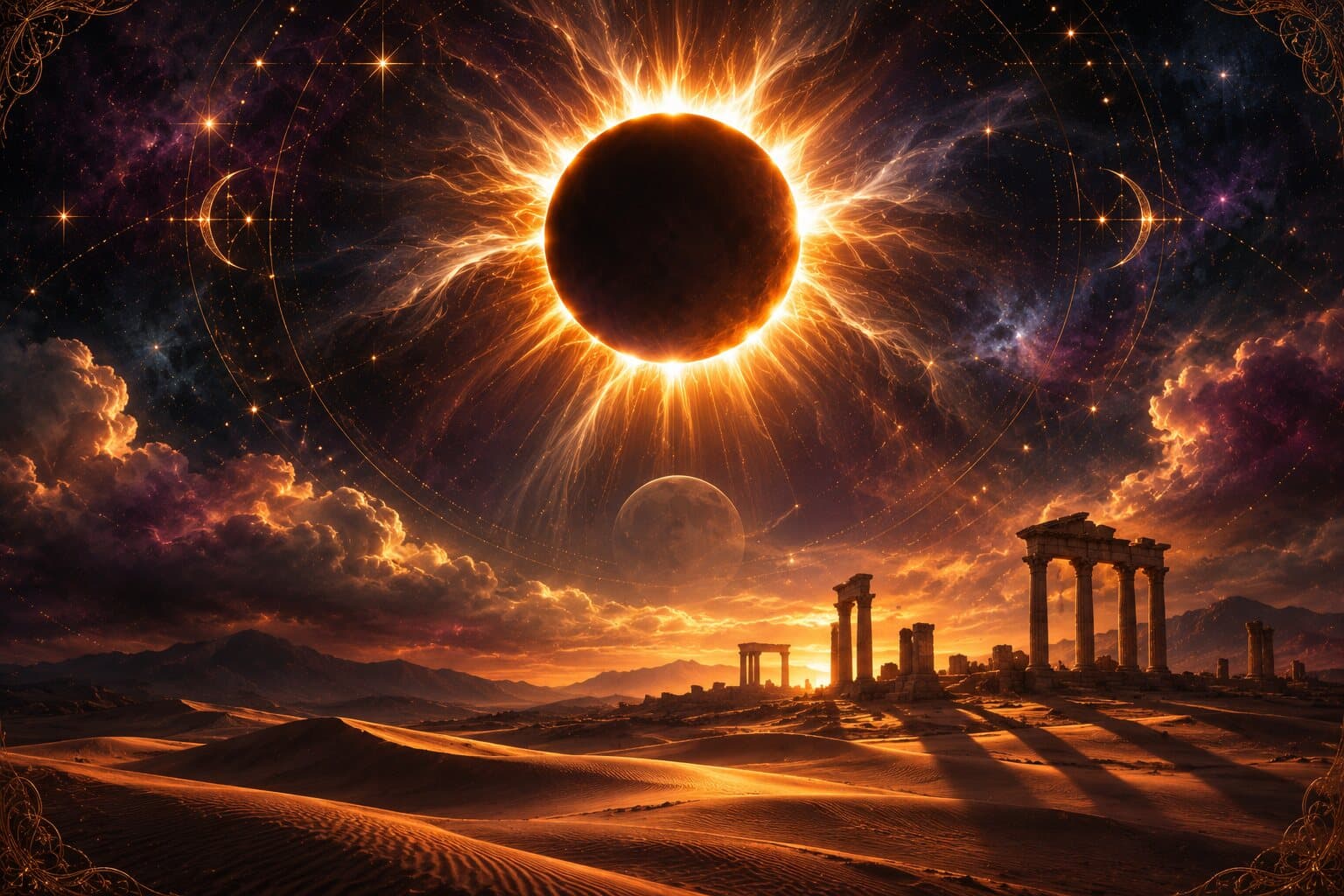
There are five eclipses in 2027: an annular solar eclipse on February 6, a penumbral lunar eclipse on February 20, another on July 18, a total solar eclipse on August 2 and a final penumbral lunar eclipse on August 17. The August 2 total eclipse in Leo is the headline, with totality lasting more than six minutes at its longest.
Eclipses are only one layer of the year. For the retrogrades, the new and full moons and the slow planets, see our 2027 astrology calendar. This piece stays with the eclipses: when they happen, where they can be seen and how astrologers tend to read them.
Astrology here is a lens for reflection and entertainment. Nothing below is medical, legal, financial or psychological advice, and an eclipse does not decide anything for you.
What are the eclipse dates in 2027?
All dates below are in Universal Time (UT). The February 20 full moon falls late in the evening UT, so in Turkey and further east it is already February 21.
| Date (UT) | Eclipse type | Sign | Where it is seen |
|---|---|---|---|
| February 6 | Annular solar eclipse | Aquarius | Ring of fire over Chile, Argentina, the Atlantic and the West African coast |
| February 20 (21 in Turkey) | Penumbral lunar eclipse | Virgo full moon | A faint dimming of the Moon |
| July 18 | Penumbral lunar eclipse | Capricorn full moon | So slight it is almost impossible to notice |
| August 2 | Total solar eclipse | Leo new moon | Totality from southern Spain across North Africa to Saudi Arabia, Yemen and Somalia |
| August 17 | Penumbral lunar eclipse | Aquarius full moon | A faint dimming of the Moon |
Notice the imbalance. The two solar eclipses are dramatic events in the sky, while the three lunar ones are penumbral, meaning the Moon only brushes the pale outer edge of Earth's shadow. Most people will not see any change in the Moon on those nights unless they know to look for it.
Why is the August 2, 2027 total solar eclipse so special?
The total solar eclipse of August 2, 2027 is one of the longest of this century. At its maximum, totality lasts more than six minutes, and it is often described as the longest totality visible from land until 2114. The path of totality crosses southern Spain, Morocco, Algeria, Tunisia, Libya and Egypt, where it passes over Luxor, then moves over Saudi Arabia, Yemen and Somalia.
From Turkey the eclipse is partial. The Moon covers part of the Sun, the light changes subtly and the sky does not go dark, so anyone hoping for totality has to travel south to the path. Never look at the Sun during any phase of a solar eclipse without certified eclipse glasses or a proper solar filter, because a partial eclipse can still damage your eyes.
Astrologically, this eclipse is a new moon in Leo. It also arrives one week after Jupiter leaves Leo for Virgo on July 26, which many astrologers read as a handover from a year of self-expression toward a phase of repair and detail.
What is an eclipse season?
An eclipse can only happen when a new or full moon falls close to one of the lunar nodes, the two points where the Moon's tilted orbit crosses the Sun's apparent path. The Sun reaches the neighbourhood of a node roughly every six months, and the few weeks around that moment are called eclipse season. That is why eclipses come in clusters.
In 2027 the nodes sit on the Aquarius and Leo axis, with the North Node in Aquarius and the South Node in Leo. The first season runs through February (Aquarius and Virgo), and the second, longer one stretches from mid July to mid August (Capricorn, Leo, Aquarius). The Virgo and Capricorn lunar eclipses sit just outside the axis signs because an eclipse only needs to fall near a node, and near can cross a sign boundary.
What do the 2027 eclipses mean in astrology?
Astrologers have long treated an eclipse as a stronger version of an ordinary new or full moon. The usual reading is that a solar eclipse opens a chapter and a lunar eclipse closes or reveals one. The descriptions below are interpretive themes, separate from the astronomy above.
February 6: annular solar eclipse in Aquarius
Aquarius is linked with friendship, groups, technology and ideas about the future. An annular eclipse leaves a bright ring of Sun around the Moon, and some astrologers read that image as a beginning that still carries something old at its edges. Themes often named: a new circle, a shared project, a change in how you belong.
February 20 and July 18: quiet lunar eclipses
The Virgo eclipse touches routines, health habits and work. The Capricorn one, the faintest of the year, touches duty and long plans. Because both are penumbral, many astrologers treat them as soft nudges, the kind you notice only if you are paying attention.
August 2: total solar eclipse in Leo
Leo rules creativity, children, romance, pride and the wish to be seen. With the South Node in Leo, the common reading is release: letting go of an old way of performing or seeking approval. A total eclipse close to the South Node is read as the strongest note of that release theme in the year.
August 17: lunar eclipse in Aquarius
Two weeks later the full moon in Aquarius closes the season on the North Node side. The themes return to community and to the future you are actually building with other people.
Which zodiac signs feel the 2027 eclipses most?
In traditional practice, the signs most touched by the 2027 eclipses are the fixed signs: Leo and Aquarius first, then Taurus and Scorpio, which square the axis. Virgo, Pisces, Capricorn and Cancer may feel the lunar eclipses that fall in or across from them. Sun signs give only a rough picture, though, because what matters most is where the eclipse lands in your own chart.
- Find which houses hold Aquarius and Leo in your Birth Chart. That life area is where astrologers would expect eclipse themes to show up.
- Check whether your Sun, Moon or rising sign sits in Leo or Aquarius. Those placements are usually read as the most activated.
- Look at planets in Taurus and Scorpio, which form a square to the axis and can feel pressure.
- Notice your own history. Many people track what happened in their lives around earlier eclipses on the same axis and compare.
A birth chart with an accurate time makes this much clearer, since the houses depend on the minute you were born.
How do you work with eclipse season without fear?
Older astrology books are full of warnings about eclipses. Most contemporary astrologers read them as periods of speed and visibility, when things already in motion come to light. A calm approach helps.
- Use the week around each eclipse to notice what comes up, and write it down.
- If a decision is already ripe, an eclipse is no reason to delay it. If it is not ripe, an eclipse is no reason to rush it.
- Keep your plans flexible around the August cluster, when three eclipses fall within one month, from July 18 to August 17.
- Look back at your notes six months later. Patterns are easier to see from a distance.
Eclipses also overlap with other cycles. The second Mercury retrograde of 2027 ends on July 4, two weeks before the summer eclipse season opens on July 18, and the Mars retrograde in Virgo and Leo earlier in the year has already spent time in Leo, the sign the August eclipse lights up.
What should you check in your own chart before the eclipses?
Start with the dates and mark them on a calendar; our moon calendar lists each new and full moon by sign. Then find the house where Leo and Aquarius fall for you. That single step turns a general forecast into something that speaks to your own life.
If you want to see your placements, a Faltastik astrology reading calculates your natal chart from your birth date, time and place, including the Sun, Moon, planets, rising sign and the 12 houses. With that in hand, you can read the 2027 eclipses as questions to sit with, and the answers stay yours.
